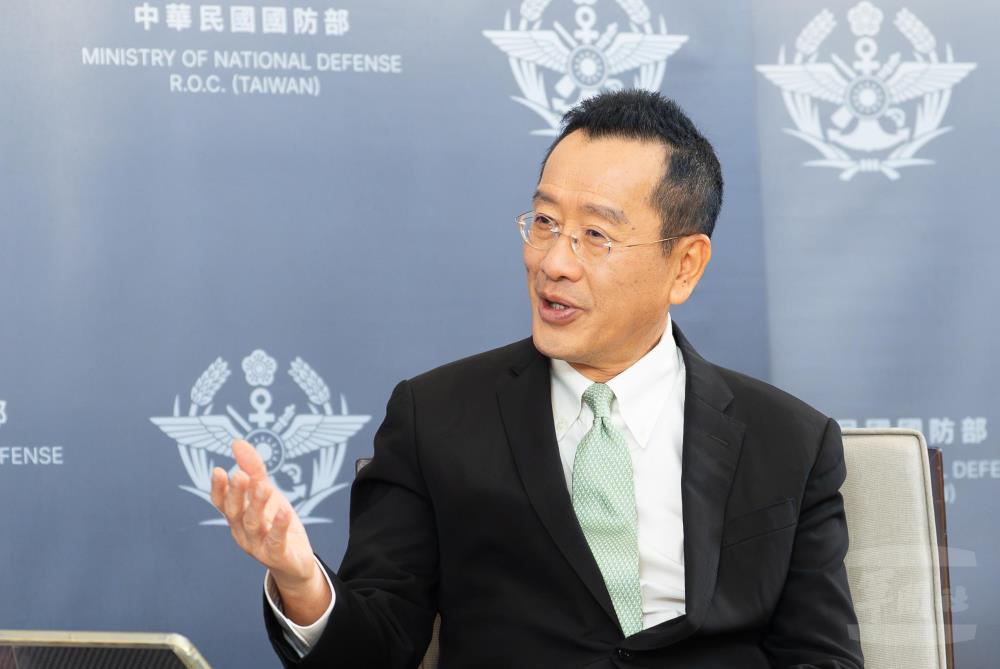
Minister of National Defense Wellington Koo Li-hsiung said in a recent media interview that, in the face of China’s escalating military threats, Taiwan will strengthen its self-defense capabilities while deepening security cooperation with like-minded countries to create collective deterrence. The Ministry of National Defense is also advancing programs for the domestic production of unmanned systems, counter-drone capabilities, and the “Taiwan Dome,” using layered defense and intelligence fusion to enhance Taiwan’s overall defense capabilities.
Minister Koo recently sat down for interviews with the Central News Agency and other media outlets, accompanied by Vice Chief of the General Staff (Executive) General Huang Chih-wei, Director-General of the Department of Strategic Planning Lieutenant General Huang Wen-chi, and Deputy Chief of the General Staff for Operations and Planning Lieutenant General Hou Chia-lun. During the interviews, he responded to questions on regional security, security cooperation, defense self-reliance, and unmanned systems.
Addressing security in the Indo-Pacific, Minister Koo said countries should increase defense spending, strengthen their self-defense capabilities, expand training, and bolster their military capabilities. Together, these efforts can create collective deterrence against any attempt to unilaterally alter peace and stability across the Taiwan Strait through force or coercion, requiring China to consider the potential responses of both Taiwan’s Armed Forces and other countries in the region before taking such action.
Minister Koo noted that the waters east of Taiwan are also vital sea lines of communication for Japan and South Korea. Should the regional security environment undergo a major change, Taiwan would not be the only country required to confront and address the consequences. Regarding Japan’s concept of a “survival-threatening situation,” Minister Koo said Japan is itself facing pressure from Chinese gray-zone activities and joint Chinese-Russian patrols. If Japan determines that circumstances have reached the threshold of a survival-threatening situation, whether it exercises its right of self-defense is a decision for the Japanese government to make based on its own assessment.
Turning to Taiwan-U.S. security cooperation, Minister Koo stressed that cooperation extends far beyond the arms sales visible to the public and encompasses a broad range of areas. Personnel seen participating in exchanges during exercises and training activities represent only a small part of the overall relationship. The Armed Forces will continue drawing lessons from the operational experience of friendly partners and adapting them to Taiwan’s defense requirements, the threats it faces, and PLA tactics and methods. These lessons will inform adjustments to Taiwan’s own tactics, techniques, exercises, and training to enhance its defensive capabilities.
On defense self-reliance, Minister Koo said Taiwan possesses highly flexible manufacturing capabilities. Going forward, Taiwan will integrate expertise from various countries in defense industries and emerging technologies while excluding supply chains that pose security concerns, including Chinese flight-control systems and communications modules. To this end, the Ministry has proposed a NT$210 billion special budget for unmanned systems, focusing on coastal surveillance and reconnaissance drones, coastal attack drones, and small one-way attack unmanned surface vessels. Through sustained, large-scale demand from the Armed Forces, the Ministry hopes to encourage domestic manufacturers to invest and establish a comprehensive production chain at scale that is free from China-linked supply chains.
On counter-drone capabilities, Minister Koo noted that a wide range of soft-kill and hard-kill options are available, including electronic jamming, lasers, high-power microwave systems, automated gun turrets, and various interceptors. The Armed Forces will deploy appropriate countermeasures based on unit echelon, threat type, and cost-effectiveness. Technologies that have reached sufficient maturity will be advanced through formal acquisition programs or small-batch procurement, while the National Chung-Shan Institute of Science and Technology (NCSIST) will continue related research and development. Counter-drone capabilities must also be integrated into the broader air-defense and fire-coordination architecture so that the most efficient countermeasure can be assigned according to the nature of each threat.
Asked about progress on the “Strong Bow” missile and the “Taiwan Dome,” Minister Koo said the Strong Bow missile has completed testing and evaluation and will be included in the relevant budget. The Taiwan Dome, meanwhile, is intended to establish a layered defense encompassing capabilities against ballistic missiles, combat aircraft, long-range fires, and unmanned systems. The Armed Forces will integrate U.S.-made and domestically developed systems, enhance the capabilities of various sensors, and fuse the intelligence and data they provide. The most appropriate effector can then be assigned according to the nature of the threat, improving the efficiency of fires across the overall air-defense architecture.
Asked about weapons and equipment acquisition, Minister Koo said future procurement will emphasize mobility, survivability, and operational flexibility, while also reducing the identifiability of military assets and employing a diverse range of platforms to perform missions. Director-General of the Department of Strategic Planning Lieutenant General Huang Wen-chi added that the Armed Forces have moved away from the former mindset of simply “buying what is available.” Systems and platforms are now evaluated according to their suitability for the defense of Taiwan and Penghu, with dual-use, military, and civilian platforms all considered in force-development planning.
Regarding legislative review of the special budget for unmanned systems, Minister Koo said the Ministry of National Defense continues to hope that the Executive Yuan’s NT$210 billion proposal will be approved and will maintain dialogue with the Legislative Yuan. If the Executive Yuan’s version does not pass, the relevant programs would have to return to the annual budget process. However, he cautioned against placing all categories of unmanned systems, including aerial, surface, ground, and underwater platforms, along with testing facilities and industrial development expenditures, under a single NT$40 billion annual ceiling, as doing so could constrain future capability development and force-development flexibility.
Minister Koo added that, beyond the unmanned systems and Strong Bow missile programs already discussed, the Ministry is continuing to advance programs involving Rui Yuan UAVs, counter-drone systems, ammunition production, and Tactical Assault Kit (TAK) capabilities. A supplementary budget is also being prepared. The Ministry will continue proposing the defense funding required under its joint operations plans, capability-development priorities, and actual operational requirements to strengthen Taiwan’s indigenous defense industry and overall defense capabilities.