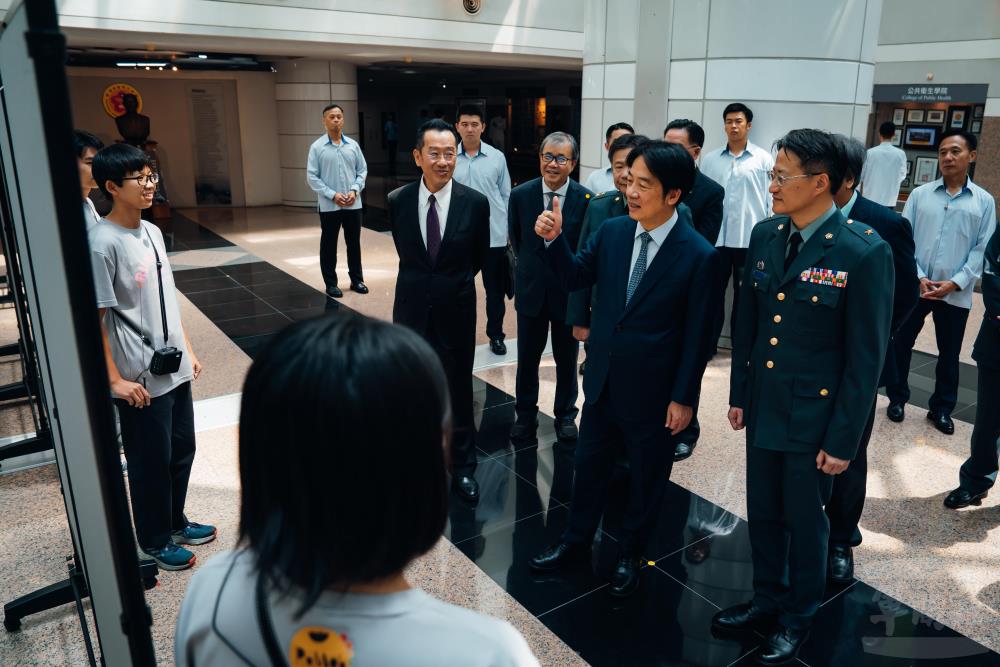
President Lai Ching-te this morning presided over the “Inauguration Ceremony of the National Defense Medical University,” commending the decades-long profound contributions of the National Defense Medical Center to the development of military medicine and offering three expectations for the newly elevated National Defense Medical University:
1. Cultivate medical students with global vision, humanistic literacy and the school motto of “universal love and loyalty”
2. Continuously advance Taiwan’s public health research and infectious disease prevention capabilities to contribute to the nation
3. Continuously improve field military medicine drawing on the combat casualty care experience of the United States and other countries to enhance ROC Armed Forces combat effectiveness and strengthen overall societal defense resilience
The ceremony was held this morning at National Defense Medical University. President Lai joined distinguished guests in unveiling the plaque for “National Defense Medical University,” inspected the Combat Trauma and Disaster Medical Training Center and the Medical Technology Education Center, and received briefings on service activities from international volunteer teams from Nepal, Indonesia, Cambodia, Mongolia, India, and Malaysia, gaining insight into combat casualty care training missions and the application of medical technology courses and teaching methods.
In his address, President Lai stated that the National Defense Medical Center was officially upgraded to “National Defense Medical University” on August 1, 2025. After decades of effort by the National Defense Medical Center, its achievements have greatly benefited the nation, society, and the people, earning widespread recognition. The elevation to university status today further demonstrates the nation’s strong support for military medicine development. He felt honored to personally preside over the inauguration ceremony, witnessing this historic moment together, and on behalf of the people extended congratulations, wishing the university continued prosperity. He believes the university will shoulder even greater missions in the future, continuing to serve the nation, society, and the people.
During the event, President Lai commended the contributions of all physicians from the former National Defense Medical Center to society, noting that residents of Jinshan, Wanli, and Keelung areas often choose Tri-Service General Hospital for serious illnesses, demonstrating that its primary care services are deeply trusted. Furthermore, National Defense Medical University is the only higher education institution in the nation that combines military missions with medical education—a cradle for cultivating dual-mission heroes. As a president from the medical profession and Commander-in-Chief of the Armed Forces, he will shoulder the responsibility to support the university’s development without reservation. He also looks forward to Major General Lin Chih-yuan, President of National Defense Medical University, building on the solid foundation laid by previous presidents to elevate contributions even further.
President Lai encouraged National Defense Medical University to continue refining its efforts in cultivating medical students with global vision, humanistic literacy, and the school motto of “universal love and loyalty” while deepening community service. Military hospitals, including Tri-Service General Hospital, were not established solely to serve the armed forces; in peacetime they also care for public health. He hopes they will continue to improve and expand in the future.
President Lai pointed out that National Defense Medical University is the only institution in the nation equipped with a Biosafety Level 4 laboratory—a rare asset. He noted that global infectious diseases emerge roughly once every one or two decades, varying in scale, such as SARS in 2002 or COVID-19 in 2019, all of which posed threats to Taiwan as well. He hopes the university will make good use of this resource to continuously advance Taiwan’s public health research and infectious disease prevention capabilities, contributing to the nation.
President Lai further stated that what distinguishes National Defense Medical University from ordinary medical universities is its expertise in field military medicine and combat casualty care training. Continuous improvement in these areas will greatly benefit ROC Armed Forces combat effectiveness and even overall societal defense resilience. Taiwan should continue to advance field military medicine, learn from the combat casualty care experience of the United States and other countries through international cooperation, and utilize AI, AR, and VR as learning tools.
Finally, President Lai once again encouraged National Defense Medical University, following its elevation, to continue advancing in three major areas: medical services, infectious disease prevention and control, and field military medicine and combat casualty care training, extending these efforts nationwide. He believes this will greatly benefit the nation.
Attendees included Presidential Office Senior Advisers Tong Yong and Shen Rong-tsong, Strategic Adviser Huo Shou-yeh, National Security Council Secretary-General Joseph Wu, Minister of National Defense Koo Li-hsiung, Minister of Education Cheng Ying-yao, Minister of Health and Welfare Chiu Tai-yuan, Veterans Affairs Council Chairman Yen Te-fa, Director-General of the Medical Affairs Bureau Major General Tsai Chien-sung, and President of National Defense Medical University Major General Lin Chih-yuan.