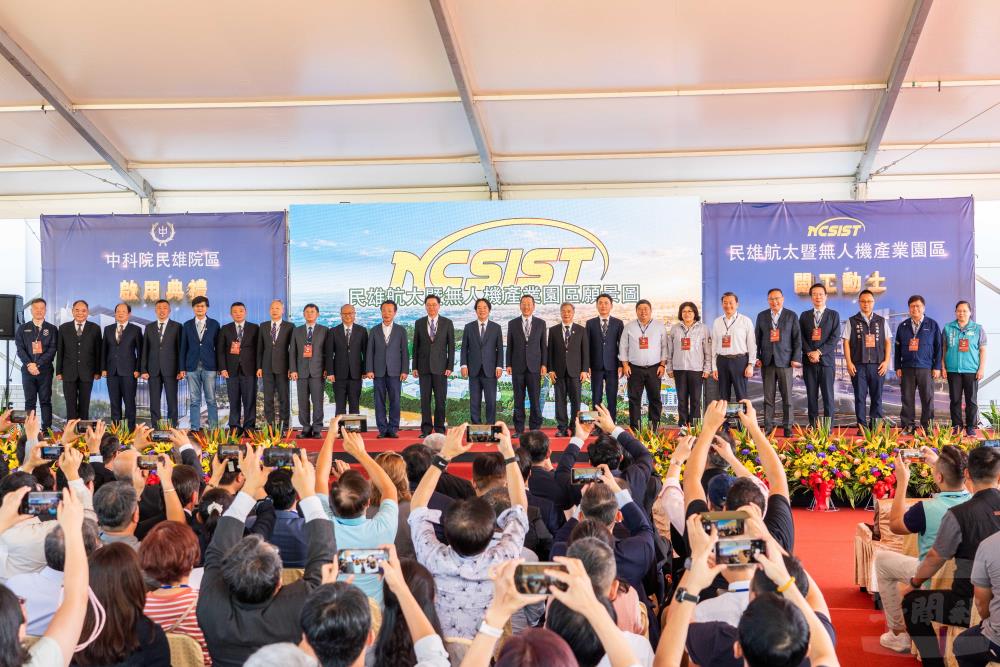
President Lai Ching-te traveled to Chiayi this morning to preside over the groundbreaking ceremony for the Minxiong Aerospace and UAV Industrial Park of the National Chung-Shan Institute of Science and Technology (NCSIST), as well as the inauguration of the institute’s Minxiong Campus. The ceremony marked a major milestone in Taiwan’s aerospace and drone development. President Lai stated that amid changes in the international security environment, unmanned systems have become an essential component of modern defense. With world-class semiconductor and information and communications technology capabilities, as well as a strong foundation in precision manufacturing, Taiwan is well positioned to develop the industry. The government, he said, will continue investing resources and deepening cooperation with democratic partners to build a safer and more resilient drone supply chain, gradually establishing Taiwan as “Asia’s hub for democratic drone supply chains.”
Upon arrival, President Lai first visited the Fude Temple to pray for the project’s success. He then joined attending guests for the groundbreaking and inauguration ceremonies before touring the hangar facilities.
In his remarks, President Lai stated that the newly inaugurated Minxiong Campus is located on the eastern side of the site. NCSIST invested more than NT$1.1 billion to construct a drone systems integration and testing hangar, research facilities, an R&D building, and supporting infrastructure. The campus will undertake the research, development, testing, verification, and production of military-grade drones. The industrial park that broke ground today is located on the western side of the site. The central government is investing nearly NT$6.9 billion in the project, which is scheduled for completion in 2028. The park will include production facilities, laboratory equipment, a flight-testing site, and R&D spaces, attracting companies from Taiwan and abroad.
President Lai stated that the opening of the Minxiong Campus signifies the establishment of national-level drone R&D and production capacity in Chiayi. The industrial park will promote the transfer of related technologies and capabilities to the private sector, supporting the large-scale development of Taiwan’s drone industry and transforming Chiayi from an R&D and testing base into a key national hub for drone development.
The President said that today’s achievements represent years of cooperation between the central and local governments. Former President Tsai Ing-wen inaugurated the Asia UAV AI Innovation Application R&D Center in 2022, construction of the Minxiong Campus began in 2023, and today marks both the campus’s inauguration and the start of construction on the industrial park.
President Lai recalled visiting the Asia UAV AI Innovation Application R&D Center and meeting with industry representatives before assuming office in 2024. Their ambition and ability to take action further convinced him that Taiwan possessed the capabilities needed to develop a competitive drone industry. Today’s ceremony, he said, represents an important step toward making Taiwan “Asia’s hub for democratic drone supply chains.”
President Lai commended the Chiayi County Government for repurposing existing school buildings to establish the Asia UAV AI Innovation Application R&D Center during the early stages of the industry’s development and for proactively seeking central government resources. He also thanked Legislator Tsai Yi-yu and other legislators for securing support in the Legislative Yuan and helping advance the related projects. The President emphasized that Chiayi’s transformation in recent years demonstrates how visionary and effective local governance can change a city’s future. He expressed hope that Chiayi will continue steadily along this path of transformation.
President Lai stated that the strategic significance of these initiatives has become increasingly evident amid changes in the international landscape. From the battlefield in Ukraine to security in the Indo-Pacific, unmanned systems have become a vital element of modern defense. Taiwan possesses world-class capabilities in semiconductors and information and communications technology, as well as a strong foundation in precision manufacturing. From last year through 2030, the Ministry of Economic Affairs plans to invest NT$44.2 billion to comprehensively strengthen the drone industry and support its continued development.
President Lai further pointed out that Taiwan’s drone industry generated NT$12.9 billion in output last year, more than 2.5 times the figure recorded the previous year. More than 267 companies are currently engaged in systems integration and the manufacture of critical components. These achievements demonstrate that Taiwan’s drone industry is expanding rapidly. Going forward, the government will create stable demand to encourage companies to invest in R&D and expand mass production. It will also assist companies in obtaining international certifications, enabling Taiwan to progress from a supplier of components to a provider of complete system solutions and trusted production capacity.
President Lai also called on legislators across party lines to support the Ministry of National Defense’s proposed supplementary budget of nearly NT$60 billion. The funding would be used to procure products from domestic companies and promote the independent development of Taiwan’s drone industry. He remarked that Taiwan’s drone industry “has everything in place and needs only one final push,” and urged the Legislative Yuan to lend its support.
The President stated that Taiwan must also deepen cooperation with democratic partners to jointly build a safer and more resilient drone supply chain, providing strong support for peace and stability in the Indo-Pacific. Chiayi, he said, is the central base for advancing this national strategy. Chiayi has long been one of Taiwan’s leading agricultural counties. The Asia UAV AI Innovation Application R&D Center in Taibao, the NCSIST Minxiong Campus, the Chiayi Coastal Unmanned Vehicle Testing Zone, and the industrial park that broke ground today are now becoming interconnected, gradually forming Taiwan’s most comprehensive drone development base. President Lai congratulated and thanked Chiayi County for taking on this important mission for Taiwan at this pivotal moment.
President Lai emphasized that the central government will continue working alongside local government to help the industry establish firm roots and cultivate local talent. These efforts will provide more young people with opportunities to build their careers in Chiayi while ensuring that the benefits of major national initiatives are shared by the public.
The National Science and Technology Council recently announced a public consultation on the Chiayi Science Park Expansion Project (Phase II Expansion). The expanded park is expected to accommodate industries including semiconductors, artificial intelligence, silicon photonics, quantum computing, and next-generation communications technologies such as 5G and 6G. President Lai expressed hope that the future leaders of Chiayi County and Chiayi City will continue working together to foster prosperity and development across the region while supporting Taiwan’s security and the growth of its advanced industries. In closing, President Lai wished the Minxiong Campus every success in its operations and expressed hope that the industrial park would be completed on schedule and to the required standards.
Also attending the event were National Security Council Secretary-General Joseph Wu; Minister of National Defense Wellington Koo Li-hsiung; Minister of Economic Affairs Kung Ming-hsin; NCSIST President Li Shih-chiang; Chiayi County Magistrate Weng Chang-liang; and Legislators Tsai Yi-yu, Wang Mei-hui, Wang Yi-chuan, Wang Ting-yu, Chen Kuan-ting, and Wang An-hsiang.