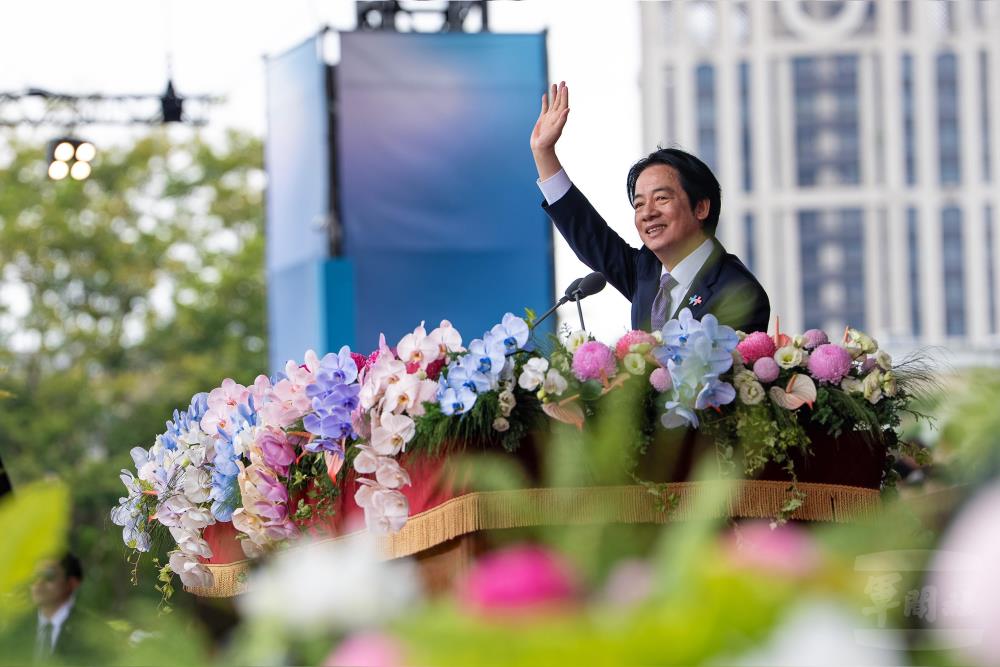
President Lai Ching-te attended the 2026 National Day Celebration of the Republic of China, held this morning at the plaza in front of the Presidential Office Building. In an address titled “Taiwan’s Future: A City upon a Hill, the Salt and Light of the World,” the President reviewed Taiwan’s democratic development, economic achievements, and international cooperation. He emphasized that, amid war and the expansion of authoritarianism, the government will continue advancing defense reforms, strengthening asymmetric capabilities, developing an autonomous defense industry, and integrating the resources of the central and local governments and the private sector to enhance whole-of-society defense resilience. Through concrete action, Taiwan will safeguard national security and maintain peace and stability across the Taiwan Strait and throughout the Indo-Pacific.
President Lai said that this year marks the 30th anniversary of Taiwan’s first direct presidential election. Thirty years ago, despite missile threats, the people of Taiwan courageously entered polling stations and exercised their right to determine their own future through the ballot box. In doing so, they affirmed that sovereignty rests with the people and that Taiwan’s future must be decided by its people. He stated that Taiwan’s democratic transition and successive transfers of power have further demonstrated that freedom and democracy do not conflict with economic development. Only by continuing to embrace democracy and engage with the world can Taiwan create prosperity and contribute to the international community.
Turning to national development, President Lai said that Taiwan had faced multiple challenges over the past year involving the global economy, energy, and supply chains, yet continued to demonstrate remarkable resilience. Taiwan achieved strong results in economic growth, stock market performance, and international competitiveness, accomplishments made possible by the sustained efforts of people across the nation and every sector of the economy. The President emphasized that national progress should not be measured solely by output and exports. Greater attention must also be given to workers’ compensation, household financial burdens, care for older adults, and the future of younger generations. Through higher wages, tax reductions, expanded benefits, and measures to ease financial burdens, the government will ensure that all citizens share in the benefits of economic development.
On policies affecting people’s livelihoods, President Lai said the government will continue addressing the challenges posed by declining birthrates, an aging population, housing pressures, and labor shortages. It will improve support for childbirth, childcare, and education; advance Long-Term Care Plan 3.0 and social housing initiatives; and strengthen healthcare, the social safety net, and energy resilience to provide greater security in people’s daily lives. He stated that people’s well-being is the foundation of national development. Through pragmatic governance, the government will improve public welfare, enable every family to live with peace of mind, and create a better environment in which the next generation can thrive.
President Lai said Taiwan continues to deepen cooperation with international partners by responding to their needs in areas including healthcare, agriculture, energy, technology, education, and sustainable development. Taiwan will also continue advancing key strategic industries, including semiconductors, artificial intelligence, defense, security and surveillance, and next-generation communications. By integrating traditional industries with technological innovation, Taiwan will strengthen supply chain resilience and international competitiveness, transforming its industrial strengths into momentum for national development.
Addressing the regional security situation, President Lai emphasized that Taiwan cherishes peace but will not relinquish freedom, and is willing to engage in exchanges but will not accept being diminished. In the face of China’s continued military and gray-zone pressure and attempts to alter the status quo across the Taiwan Strait, the government will continue advancing defense reforms, strengthening asymmetric capabilities, and developing an autonomous defense industry. Taiwan will transform its strengths in semiconductors, information and communications technology, and precision manufacturing into capabilities that safeguard the nation. The President also stated that increased defense investment is intended not to provoke conflict, but to deter war. Strengthening self-defense does not mean abandoning dialogue; rather, it ensures that dialogue can take place on the basis of equality and dignity.
President Lai said whole-of-society defense resilience is an essential foundation of national security. The government will integrate the capabilities of the central and local governments and the private sector to strengthen operational continuity in such critical areas as energy, communications, transportation, finance, food supplies, and healthcare. This will ensure that society can continue functioning steadily during a crisis and that people can protect themselves and assist one another. He also thanked the members of the Armed Forces, reservists, police officers, firefighters, healthcare professionals, civil defense personnel, and citizens who have participated in exercises. He recognized their preparedness and training as a collective line of defense for Taiwan’s peace and security.
President Lai emphasized that Taiwan does not seek hegemony or aim to dominate others. Instead, it regards the preservation of peace as its responsibility and seeks to serve as a trusted and stabilizing force in the international community. He welcomed dialogue between the United States and China to manage competition and reduce the risk of conflict and war. At the same time, he stressed that the history of World War II must not be distorted and that historical facts, as well as the right of Taiwan’s people to survive and prosper, must be respected. As regional conditions evolve, Taiwan will join forces with Indo-Pacific democracies to uphold regional security, peace, and stability, ensuring that force does not override rules and that powerful states cannot deprive people of the right to determine their own future.
President Lai said Taiwan’s future depends on national unity. Even when people hold different views, they should respect one another, trust the nation’s institutions, and work together to safeguard the country. He emphasized that the President’s responsibility is to unite the nation’s strength and lead the country forward. He called on the people of Taiwan to work together, laying a foundation for national development through pragmatic governance, preserving peace through steadfast democracy and strong defense capabilities, and sharing Taiwan’s achievements with the world in a spirit of innovation, equality, and goodwill. Through these efforts, Taiwan’s next generation will stand on firmer ground and go even further.