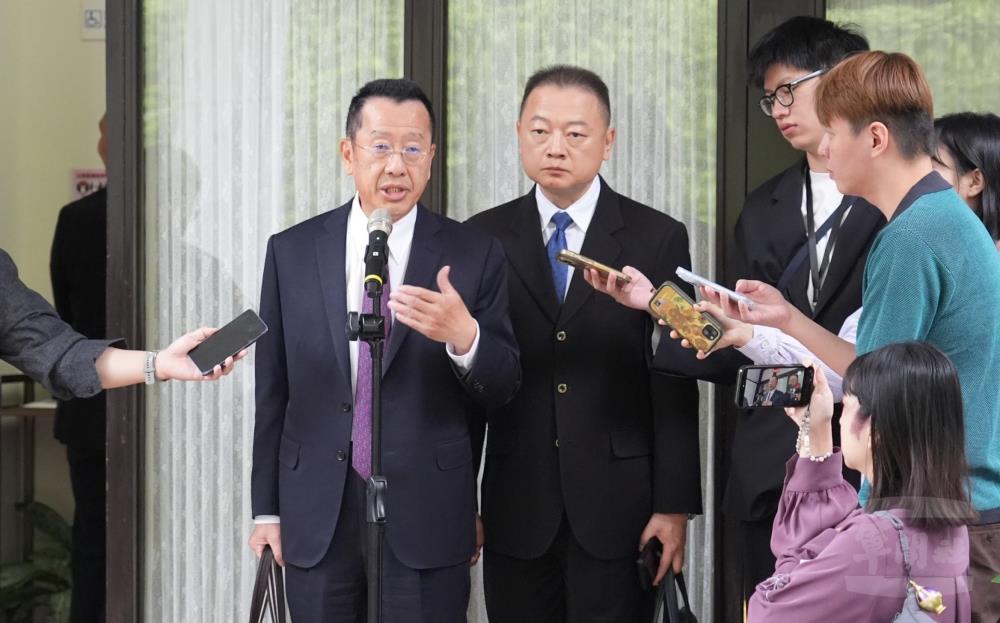
Minister of National Defense Wellington Koo Li-hsiung attended a plenary session of the Legislative Yuan today and responded to issues raised by the media, including "CCP cognitive warfare" and "ROC Armed Forces allowances." Minister Koo pointed out that the CCP deliberately chose Taiwan Retrocession Day to release satellite images showing streets in Taiwan taken by the "Jilin-1" satellite and to make provocative remarks, and that its intent to wage cognitive warfare is plainly evident.
Minister Koo stressed that the People's Republic of China was not founded until 1949 and that the War of Resistance against Japan had nothing to do with the People's Republic of China. This is a clear and objective fact. Meanwhile, October 25 also marks the 77th anniversary of the victory in the Battle of Guningtou, a reminder to the public that the CCP's determination to annex the Republic of China and Taiwan by force has not changed in the slightest, and that greater vigilance is required. In the face of such intelligence-gathering activities, the ROC Armed Forces remain on high alert at all times and continue to ensure the combat capability and security of their units through early-warning mechanisms and drills such as concealment, mobility and dispersal.
Regarding media questions on whether, given that 87% of ROC Armed Forces personnel serving in combat units receive the related allowance, a specialty allowance should also be introduced for the remaining 13%, who serve in non-frontline and higher headquarters, Minister Koo explained that the allowances of the ROC Armed Forces are not limited to the combat unit allowance but also include items such as duty allowances for various units. According to statistics, of the 13% of personnel who currently do not receive the combat unit allowance, more than 8% receive various duty allowances, while only slightly more than 4% receive none, most of whom staff officers serving at the corps level and above.
Minister Koo further stated that talent development in the ROC Armed Forces emphasizes "alternating assignments" between command and staff positions, which are part of diversified career development, and that only through such alternating assignments can the best be selected for advancement. Personnel in higher headquarters are among those developed and selected for advancement by the ROC Armed Forces, and they must gain staff experience at corps-level or higher headquarters in order to continue advancing in their careers. The Ministry of National Defense will also continue to review its various duty allowance systems.