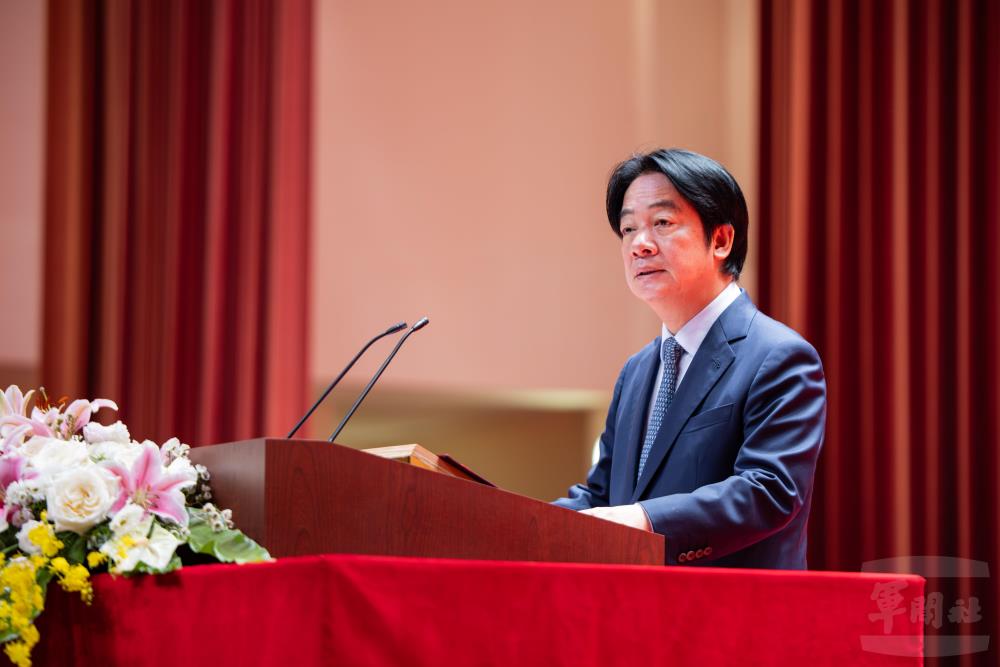
President Lai Ching-te visited the National Defense University this morning to preside over the “opening ceremony for the Class of 2027 in Advanced Military Education Program.” President Lai said that, in the face of rapidly changing international conditions and challenges posed by emerging technologies, the Armed Forces must continue upgrading and transforming into a new-generation force capable of responding to diverse challenges.
In his remarks, President Lai said he was pleased to preside over the ceremony. He congratulated the officers on passing their entrance examinations and beginning a new stage of learning. He also thanked the faculty and staff for their longstanding dedication to military education and for strengthening the Armed Forces’ professional foundations.
President Lai noted that the international landscape is changing rapidly, while China’s threats and provocations against neighboring countries are becoming increasingly serious. Artificial intelligence, unmanned systems, and space technologies are also reshaping the future and the nature of warfare. In the face of these challenges, only by continually strengthening its self-defense capabilities and enhancing military professionalism can Taiwan safeguard peace and stability across the Taiwan Strait and protect its democracy, peace, and prosperity.
The President emphasized that the Armed Forces must continue upgrading and transforming into a new-generation force capable of meeting every challenge. The success of this transformation will depend on whether leaders at all levels possess a broad perspective, professional knowledge and capabilities, and an unwavering sense of responsibility. All the officers have extensive experience in military units. Their return to the classroom reflects the nation’s higher expectations of them. Advanced military education is not about accumulating academic credentials, but about elevating their thinking, developing the ability to integrate capabilities across services and disciplines, and preparing them to assume greater responsibilities in the future.
President Lai noted that a new-generation force must embrace new training, new thinking, new equipment, and new technology. It must also be people-centered, AI-assisted, and guided by realistic combat requirements, while continually enhancing the effectiveness of joint operations and asymmetric capabilities.
During the ceremony, President Lai outlined “three imperatives” for the officers. First, they should actively cultivate strategic thinking with an international perspective. As the future leaders of the Armed Forces, they should apply what they learn to observe and assess international developments accurately, move beyond service-centric thinking, place the national interest first, and prepare and plan effectively for force development and combat readiness from an international strategic perspective.
Second, they should actively acquire new knowledge and embrace innovation and change. Technological advances are transforming warfare while testing organizations’ ability to learn and adapt rapidly. He encouraged the officers to engage proactively with artificial intelligence, unmanned systems, and the integration of information, communications, and electronic warfare capabilities, thereby strengthening their problem-solving abilities. More importantly, they should have the courage to examine established practices critically and bring the results of their learning and research back to their units, ensuring that innovation is genuinely incorporated into training, command, and decision-making.
Third, they should have the courage to assume leadership responsibilities and build trust within their teams. A leader’s value lies not only in accomplishing missions but also in leading by example, assigning people according to their strengths, recognizing the expertise and needs of every colleague, and striking a balance between rigorous standards and genuine care. Only by establishing mutual trust and maintaining discipline can leaders foster trust and cohesion within their teams, make sound decisions at critical moments, and accomplish every mission.
President Lai again reminded all Armed Forces leaders that “even when the world is at peace, forgetting war invites peril.” He emphasized that Taiwan must never relax its resolve to stand united in defending its sovereignty and safeguarding peace across the Taiwan Strait. Only by continually strengthening and investing in national defense can Taiwan “secure peace through strength.” As commander-in-chief, President Lai pledged that the government would remain the Armed Forces’ strongest source of support. It will continue providing the necessary resources and improving service members’ compensation and working and living conditions, enabling them to serve with peace of mind and devote themselves fully to defending the nation.
Finally, President Lai reminded the officers that the opening ceremony marked not only the beginning of a new learning journey but also the start of their future leadership responsibilities. He expressed confidence that their education at the National Defense University would equip them with broader perspectives, stronger capabilities, and more mature leadership, enabling them to become an important force for reform within the Armed Forces. He wished all the officers success in their studies and a rewarding educational experience. He encouraged them to turn knowledge into action and responsibility into strength, working together to safeguard Taiwan’s democracy, peace, and prosperity.
Also attending were National Security Council Secretary-General Joseph Wu; National Security Council Advisor Liu Te-chin; Minister of National Defense Wellington Koo Li-hsiung; Chief of Army General Lu Kun-hsiu; Chief of Navy Admiral Chiang Cheng-kuo; Chief of Air Force General Cheng Jung-feng; Vice Chief of the General Staff (Executive) General Huang Chih-wei; and National Defense University President Admiral Tang Hua.