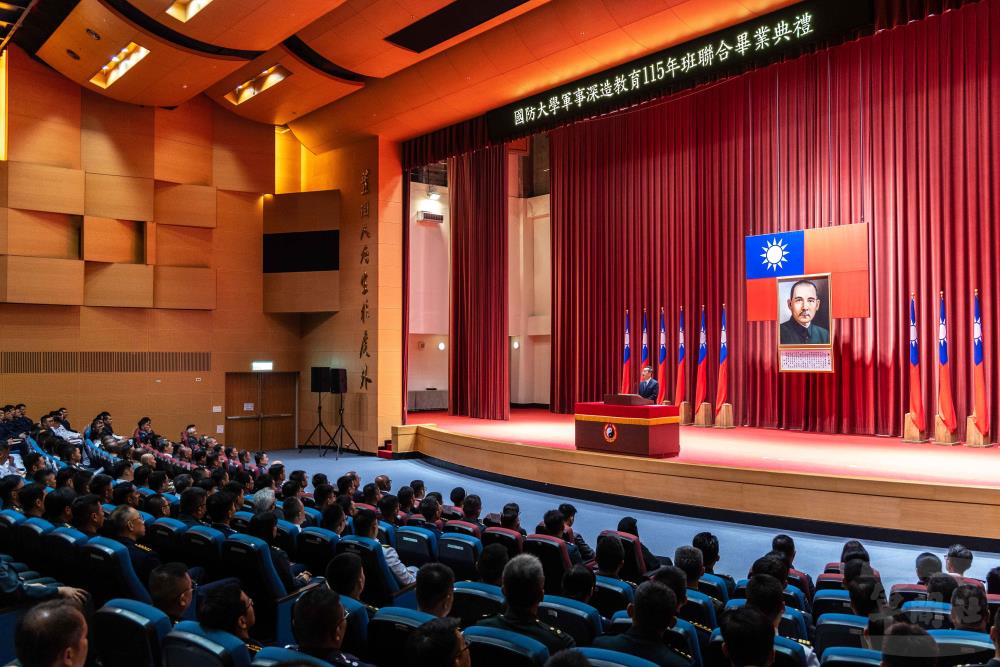
Minister of National Defense Wellington Koo Li-hsiung presided over the National Defense University’s “Joint Graduation Ceremony for the 2026 Advanced Professional Military Education Programs” today. He extended his sincere congratulations to all graduating officers and encouraged them to integrate and apply what they had learned, remain committed to their missions and values, advance reform and innovation, and exercise effective leadership in their future positions. Together, he said, they must shoulder the important responsibilities of force development and combat readiness.
The ceremony was held this morning at the University’s Shuai Zhen Campus. Minister Koo presented graduation certificates and awards to outstanding student officers, as well as service medals to officers from allied nations. Minister Koo noted that the graduation marks the conclusion of advanced education but also the beginning of new responsibilities. Faced with complex threats posed by gray-zone harassment, cognitive warfare, and emerging technologies such as artificial intelligence, the Armed Forces must continue advancing force development and combat readiness while deepening education and training to deter threats effectively.
Minister Koo outlined three expectations for the graduates: “Remain committed to your missions and values to ensure national security,” “Advance reform and innovation to strengthen defense capabilities,” and “Demonstrate effective leadership to guide the Armed Forces’ development.” He noted that in recent years, the Armed Forces have continued advancing toward the goals of “new training, new thinking, new equipment, and new technology,” guided by an approach that is “people-centered, AI-assisted, and combat-oriented toward realistic combat conditions.” Through phased, realistic exercises such as Rapid Response Exercise, Joint Defense Exercise, and Han Kuang Exercise, the Armed Forces have improved the speed and efficiency of the transition from peacetime to wartime, deepened decentralized command and control, and implemented live-fire validation throughout all operational phases, thereby continuing to strengthen defense capabilities.
Minister Koo emphasized that even the most advanced technology and equipment cannot replace human leadership and judgment. He encouraged the graduates to embrace new knowledge, make effective use of emerging technologies, and foster an organizational culture built on respect for professional expertise, trust and empowerment, fairness, and transparency. He also urged them to listen to personnel at the unit level, remain attentive to service members’ needs, and lead by example so that they and their subordinates can grow together. By applying their expertise in their respective positions, the graduates can provide fresh momentum for the modernization of the Armed Forces.