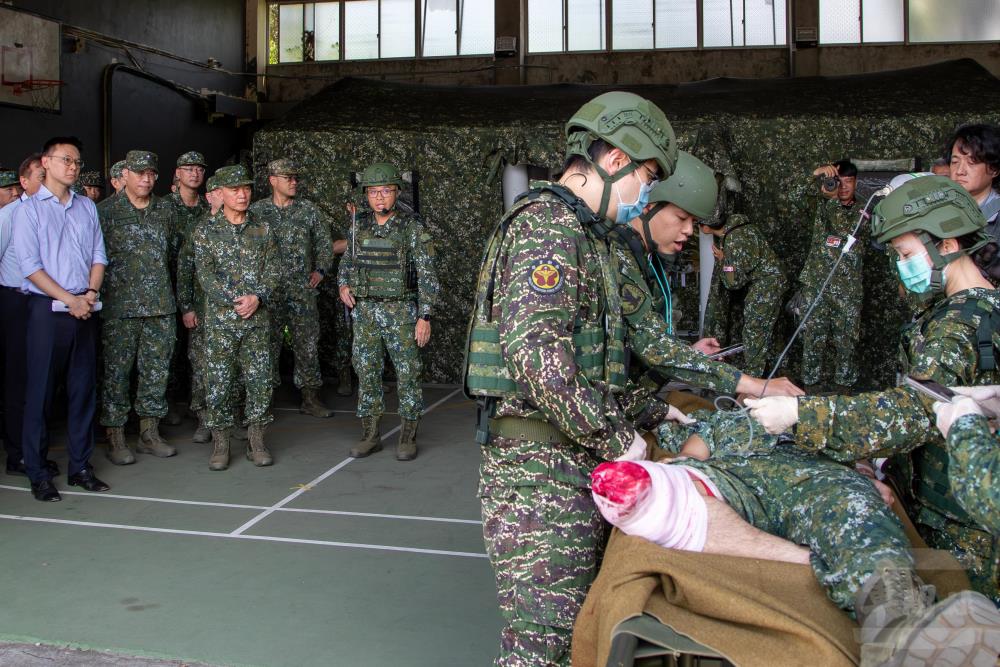
Vice Minister of National Defense General Chung Shu-ming today inspected the Armed Forces’ 2026 Fifth Theater of Operations “Military, Public, and Private Medical Integration” Exercise. Designed around realistic combat scenarios, the exercise tested the theater’s medical response capabilities under threat conditions. Participants responded calmly in accordance with standard operating procedures, fully demonstrating the resilience of the integrated medical system.
Accompanied by National Security Council Deputy Secretary-General Lin Fei-fan, Vice Chief of Army Lieutenant General Chang Tai-sung, Fifth Theater of Operations Commander Lieutenant General Shao Chih-chun, and Medical Affairs Bureau Director-General Lieutenant General Chen Yuan-hao, Vice Minister Chung visited Taichung Tianhou Temple, the Central Region Resources Branch of the Water Resources Agency, Asia University Hospital, and Taichung Armed Forces General Hospital this morning to observe the exercise.
The exercise covered combat casualty care; medical operations at casualty collection points and battalion aid stations; operations at casualty evacuation control points and by forward surgical teams; the delivery of blood products and medical supplies by drone; mass-casualty response; the establishment of underground treatment facilities and walking blood bank operations for the immediate use of freshly donated blood; and the admission and treatment of patients at veterans homes. These activities tested the medical integration mechanism across military, public, and private institutions, as well as the effectiveness of medical support operations.
Vice Minister Chung thanked the Taichung City Government, Taiwan Blood Services Foundation, Quanta Computer, and other private-sector participants for contributing to the exercise, which showcased the results of cross-sector cooperation among the military, government, and private sector. Guided by the principle that “even if there is no war for a century, combat readiness cannot be neglected for a single day,” the Armed Forces will continue integrating the capabilities of central and local government agencies and the private sector to strengthen societal and medical resilience and ensure comprehensive wartime preparedness.
Vice Minister Chung noted that an integrated military, public, and private medical system must be planned comprehensively in line with each theater’s overall operational concept, assessed threats, and national resilience requirements. Medical resources from the Armed Forces, the Ministry of Health and Welfare, and local providers must be integrated and appropriately allocated according to the different phases of operations and mission requirements. Civilian expertise in smart healthcare, blood supply, and drone logistics should also continue to be incorporated to enhance wartime medical support and overall medical resilience.
Chung explained that the exercise not only tested medical support procedures and interagency coordination, but also provided an important opportunity to determine whether medical resources had been allocated according to actual needs. Its results will be systematically compiled through observation, analysis, and after-action reviews (AARs) to inform further improvements in training and preparedness.
He further emphasized that the lessons learned should be used to develop standard operating procedures shared by military and civilian medical systems, giving every theater of operations a consistent framework to follow. Medical integration and support capabilities must continue to be refined, while exercise experience should be institutionalized. This will ensure that medical resources from all sectors can be rapidly integrated during wartime, maximize the effectiveness of medical rescue efforts, and strengthen overall emergency response capabilities.