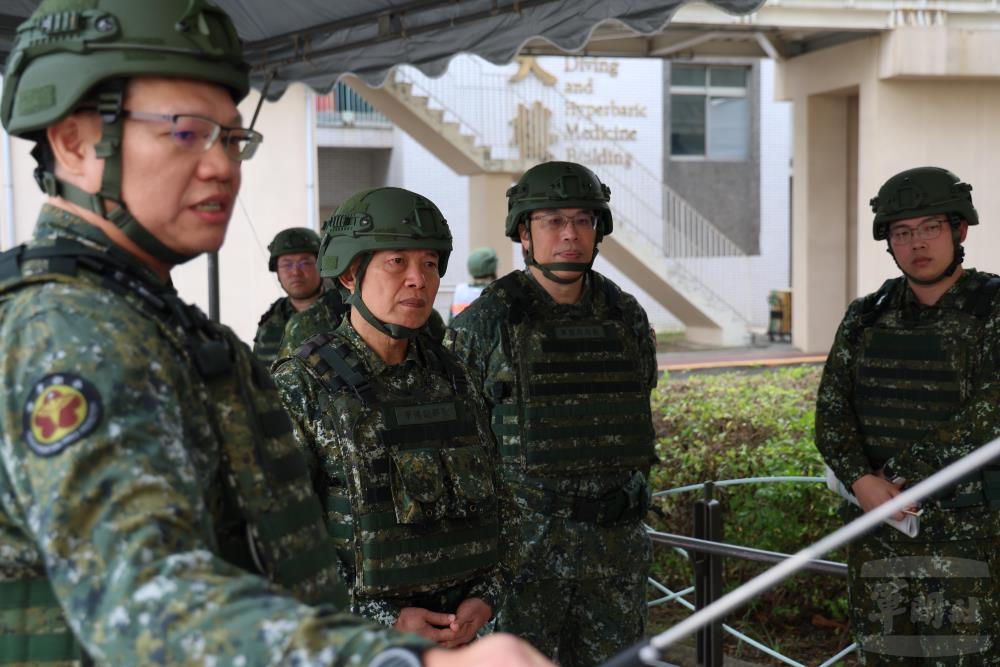
On the third day of the field-training phase of the Han Kuang 42 Exercise, Vice Minister of National Defense General Chung Shu-ming visited the Fourth Theater of Operations today to inspect a “military, public, and private medical integration” exercise involving casualty evacuation and the relocation of medical capacity. The exercise validated the large-scale relocation and preservation of medical capacity at Armed Forces hospitals, the transfer of existing patients to lower-acuity facilities, and coordination mechanisms with external organizations. Participating units completed all exercise scenarios, demonstrating their ability to integrate medical resources and relocate medical supplies.
Accompanied by Director-General of the Medical Affairs Bureau Lieutenant General Chen Yuan-hao and E-Da Hospital Superintendent Tu Yuan-kun, Vice Minister Chung visited the Zuoying Armed Forces General Hospital, Gangshan Veterans Home, Yanchao Emergency Aid Station, and E-Da Hospital. He inspected drills covering casualty evacuation, the relocation of medical supplies, the placement and care of wounded service members, and the transfer of civilian patients to appropriate facilities. In response to the exercise scenarios, participating units completed casualty triage, coordination with receiving and transferring units, applications for traffic priority along evacuation routes, interagency command-and-control communications, the dispatch of evacuation vehicles including mobilized transportation assets, the deployment of personnel including military support teams, and inventories of medical supplies and daily necessities. Through interagency coordination and cooperation, the exercise validated the wartime medical system’s operating mechanisms and emergency response capabilities.
During the exercise, the Armed Forces medical system worked closely with local health authorities, veterans care institutions, and private medical facilities. Information sharing, ambulance dispatch, and tiered medical care mechanisms enabled casualties to be rapidly sorted, evacuated, and transferred to suitable medical institutions or accommodation facilities according to their condition. These measures help ensure continuity of care and preserve medical treatment capacity during wartime and disasters.
Vice Minister Chung said the military, public, and private medical integration exercise was conducted in conjunction with the field-training phase of the “Han Kuang 42 Exercise.” Coordinated by the Ministry’s Medical Affairs Bureau, it brought together Armed Forces hospitals, private medical institutions, local health centers, and veterans homes to validate civil-military medical coordination mechanisms and response capacity under realistic conditions. The exercise not only demonstrated the progress achieved in integrating military, public, and private medical systems, but also identified a number of areas for improvement. Vice Minister Chung expressed hope that continued exercises would build experience, refine existing mechanisms, and comprehensively strengthen wartime medical support and whole-of-society defense resilience.