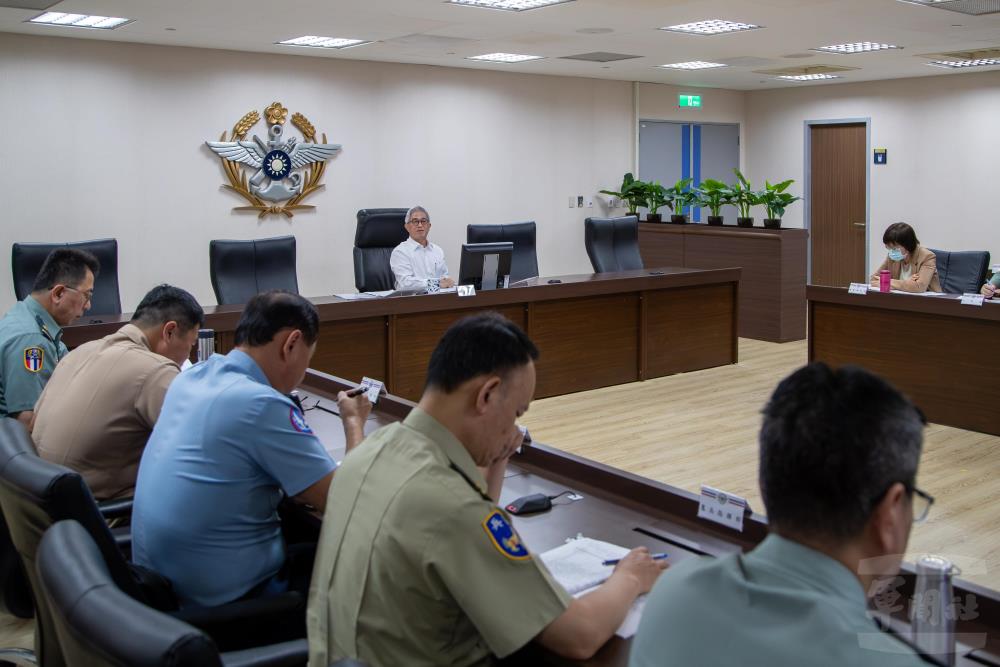
Vice Minister of National Defense Hsu Szu-chien chaired the 16th meeting of the Ministry of National Defense Bilingual Policy Steering Group today. He encouraged all units to continue refining their bilingual policy initiatives and make effective use of artificial intelligence to improve bilingual learning outcomes and the overall English proficiency of the Armed Forces.
Held this morning at the Ministry’s Bo’ai Camp, the meeting reviewed progress in implementing the Ministry’s bilingual policy. Representatives of the military services also reported on their use of AI in bilingual learning, the fielding of newly acquired military equipment, and overseas training programs. Taichung Armed Forces General Hospital and the Republic of China Air Force Academy shared their experiences, providing useful examples for other units implementing bilingual initiatives.
Regarding the application of AI, Vice Minister Hsu said that promoting bilingual learning involves more than merely introducing AI tools. It is even more important to evaluate their actual effectiveness. He recommended inviting experts to assess the advantages and disadvantages of different AI tools for bilingual learning. The findings could guide future improvements and enhance the overall quality and effectiveness of learning.
Vice Minister Hsu emphasized that exchanges between the Armed Forces and allied and partner countries involve extensive military terminology and other specialized terms. When AI is used to learn or translate military terminology, accuracy must be paramount. Errors in recognition or translation must not be allowed to create communication gaps. Machine learning and validation mechanisms should therefore be used to continually improve system recognition capabilities and specialized terminology databases, ensuring that bilingual applications meet operational needs.
Vice Minister Hsu said this year’s bilingual policy would focus on three priorities. First, the Armed Forces will integrate English instruction into specialized on-base training, use the National Development Council’s bilingual learning platform, and engage qualified instructors to strengthen service members’ English proficiency. Second, in line with data governance policy, the Ministry will establish an AI-assisted bilingual learning environment. The Office of the Deputy Chief of the General Staff for Personnel and the Office of the Deputy Chief of the General Staff for Training will oversee military academies and units in promoting self-directed learning. Third, the Ministry will continue working with the National Development Council on an interagency initiative to foster a bilingual-friendly environment and secure relevant resources, comprehensively enhancing bilingual learning outcomes across the Armed Forces.
Vice Minister Hsu commended Taichung Armed Forces General Hospital and the Air Force Academy for sharing their experience in implementing bilingual initiatives. He encouraged all units to make effective use of the National Development Council’s bilingual learning platform, refine machine-learning mechanisms, and improve the consistency and effectiveness of their systems to generate greater synergy across the initiative. He also instructed the relevant units to continue reviewing matters requiring further deliberation and to refine the implementation of the Ministry’s bilingual policies.