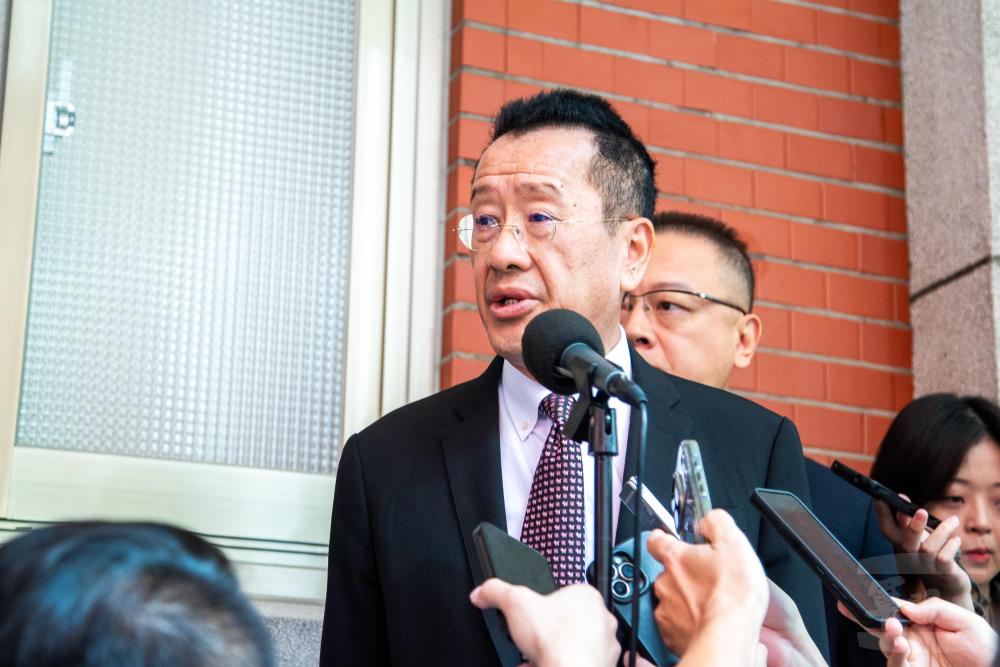
Minister of National Defense Wellington Koo Li-hsiung spoke to the media today before attending the second joint meeting of the Legislative Yuan’s Economics, Foreign Affairs and National Defense, and Finance Committees. He said that President Lai Ching-te’s inspection of military units was intended to gain an understanding of preparations for exercises and training and to encourage service members. The visit would not affect the scheduled activities or validation objectives of the Han Kuang Exercise. The Armed Forces currently have no plans to conduct live-fire drills on Taiwan proper and will not arrange any specifically for the presidential inspection.
Responding to a question about whether President Lai’s inspection would run counter to the original purpose of military training, Minister Koo explained that the exercise uses realistic training under conditions resembling actual combat to strengthen the Armed Forces’ joint operational capabilities. The President’s visit would neither disrupt routine training nor alter any scheduled activities or validation objectives.
Minister Koo also stressed that media reports claiming that the Armed Forces would conduct live-fire drills on Taiwan proper were inaccurate. Although the President’s inspection itinerary was still being adjusted, no live-fire activities would be specially arranged.
Regarding a report by the National Audit Office noting that NT$3.7 billion in maintenance funding had been allocated for the Air Force’s AT-3 trainer aircraft despite their impending retirement, Minister Koo explained that the report addressed expenditures from last year. The AT-3 fleet would not begin to be phased out until July this year, so expenses for contractor-provided maintenance and other support remained necessary. Maintenance costs will decline as the aircraft are gradually withdrawn from service.
Responding to concerns raised in the National Audit Office’s final accounts report that the Armed Forces’ counter-drone systems do not cover the 5.1 GHz frequency band or address emerging threats such as fiber-optic-controlled and AI-enabled autonomous drones, Lieutenant General Sun Li-fang, Director of the Administration Office of the Minister and Ministry spokesperson, explained that the National Chung-Shan Institute of Science and Technology launched its current counter-drone system project in 2021. The system was designed primarily to counter commercial drones operating on the 2.4 GHz, 5.8 GHz, 1.2 GHz, and 1.5 GHz frequency bands. After China introduced the use of the 5.1 GHz band in 2023, NCSIST planned a system upgrade to incorporate that band into its detection and countermeasure coverage.
Lieutenant General Sun further explained that portions of the S-band used by the BeiDou Navigation Satellite System are primarily employed for transmitting and receiving short messages and are not among the frequency bands currently used primarily by drones. These frequencies are also important to Taiwan’s domestic 4G and 5G mobile communications. Under National Communications Commission regulations, they may not be used by general-purpose/civilian drones and were therefore not included in the current counter-drone system. Fiber-optic-controlled and AI-enabled autonomous drones have emerged only in recent years and were not included in the original project. The Ministry is now working through its Defense Innovation Unit to identify mature domestic and overseas suppliers while combining commercial solutions with indigenous research and development to plan future countermeasure systems.
Addressing foreign media reports that the PLA had constructed replicas of the Presidential Office Building, government agencies, naval bases, and other facilities for simulated attack or occupation training, Lieutenant General Sun said that the facilities and related PLA activities were within the scope of the Armed Forces’ intelligence, surveillance, and reconnaissance. Following the principle of preparing for the broadest range of enemy capabilities, the Ministry is developing appropriate responses to possible PLA operations against Taiwan while continually strengthening force development, combat readiness, and training.
Lieutenant General Sun emphasized that the reports underscored the severity of the current threat. The Armed Forces will respond prudently and continue enhancing all aspects of combat readiness. He also called on the public to support both the annual defense budget and the special defense budget so the military can secure the resources required to improve its training, readiness, and defense capabilities.
Regarding the recovery of Taiwan’s share of F-16 development costs, Lieutenant General Sun explained that under US foreign military sales procedures, the maximum recoverable amount of R&D cost-sharing reimbursement under the “Peace Phoenix Rising Program” for the F-16 Block 20 is US$319 million. Approximately US$245 million has been recovered to date. The Air Force will continue using project management mechanisms and regular meetings to monitor other countries’ participation in the program and the reconciliation of foreign military sales accounts, while seeking the R&D cost-sharing reimbursement to which Taiwan is entitled.