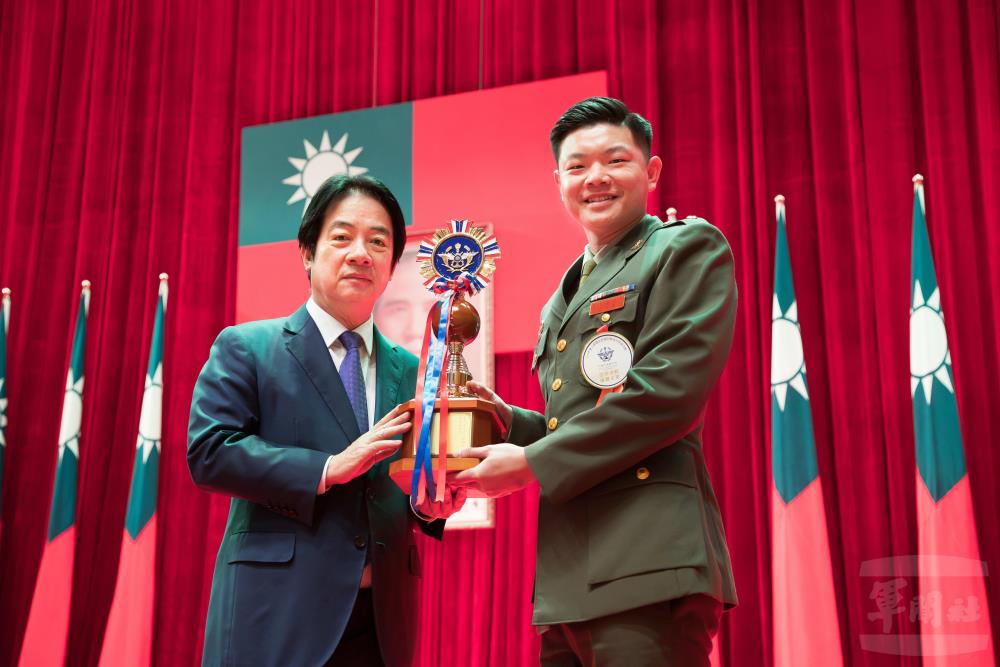
President Lai Ching-te presided over the “2026 Armed Forces Day and All-out Defense Education Day Awards Ceremony” today. He said the government would continue strengthening the Armed Forces’ combat capabilities and Taiwan’s overall defense resilience, advancing defense self-reliance, and caring for service members. He also thanked the Armed Forces for defending the homeland and all sectors of society for supporting national defense. The President called on everyone to stand united in safeguarding national security, democracy, freedom, and peace.
President Lai was accompanied by Strategic Advisors to the Office of the President Huoh Shou-yeh, Lin Chen-yi, and Liu Jen-yuan; National Security Council Secretary-General Joseph Wu; Deputy Secretary-General Lii Wen; Minister of National Defense Wellington Koo Li-hsiung; Chief of the General Staff Admiral Mei Chia-shu; Chief of Army General Lu Kun-xiu; Chief of Navy Admiral Chiang Cheng-kuo; Chief of Air Force General Cheng Jung-feng; National Defense University President Admiral Tang Hua; and Friends of Armed Forces Association Chairman Huang Cheng-tsung. During the ceremony, the President presented awards to Outstanding Armed Forces Personnel, Exemplary Armed Forces Units, organizations and individuals recognized for outstanding contributions to all-out defense education, exemplary supporters of the Armed Forces, and exemplary reserve advisory cadres. The awards recognized their exceptional contributions to national defense development, all-out defense education, military support initiatives, and reserve affairs.
In his remarks, President Lai noted that Armed Forces Day would be celebrated the following day, September 3. He said he was pleased to gather with Armed Forces personnel and extended his sincerest congratulations and gratitude to all award recipients, including outstanding personnel, exemplary units, and exceptional partners in all-out defense education, military support initiatives, and reserve affairs. Those honored today are outstanding representatives of the Armed Forces and wider society. However, every service member who defends the nation and its people deserves the public’s heartfelt respect and gratitude.
President Lai said this year’s award-winning units demonstrated the missions and responsibilities undertaken by the Armed Forces in different roles. The Assault Helicopter Group of the Army Aviation 602nd Brigade is responsible for air assaults, rapid reinforcement, and the transportation of personnel, equipment, and supplies. After Typhoon Ragasa devastated Hualien last year, the unit deployed helicopters to transport search-and-rescue personnel and equipment into the disaster area, exemplifying the Armed Forces’ commitment to defending the homeland and protecting the people. The Air Force’s 41st Tactical Fighter Group of the 2nd Tactical Fighter Wing has long performed air defense alert duties. Amid rapidly evolving conditions around the Taiwan Strait, its personnel maintain combat readiness day and night, making the unit an essential force in protecting Taiwan’s airspace. Tseng Chung-fu, chief advisor to the Southern Taitung County Advisory Group, has also provided longstanding support for national defense. Last year, he assisted the Armed Forces in establishing an artillery live-fire training range in Taimali, expanding the military’s training capacity. These achievements vividly demonstrate both the Armed Forces’ commitment to protecting the people and society’s support for the military. They are also concrete examples of all-out defense in practice.
President Lai also highlighted Marine Corps company commander Captain Tsai Yin-lan, an Outstanding Armed Forces Personnel award recipient. From becoming Taiwan’s seventh female combat frogman to working her way through the ranks to become an officer, she exemplifies the younger generation’s courage in pursuing their aspirations. The President thanked all award recipients for their contributions. He expressed hope that the ceremony would allow the public to see the Armed Forces’ efforts and achievements while helping more young people understand that wearing the uniform and defending the nation is a calling worthy of pride.
President Lai noted that this year marks the 20th anniversary of the implementation of the “All-out Defense Education Act.” Over the past two decades, all-out defense education has expanded beyond schools and government agencies into society, enabling more people to understand and support national defense and participate in strengthening whole-of-society defense resilience. Faced with rapidly changing international conditions and the continued expansion of Chinese authoritarianism, Taiwan must not only continue enhancing the Armed Forces’ combat capabilities but also ensure that both the government and society possess sufficient response capacity.
President Lai said Han Kuang 42 Exercise, completed last month, focused on realistic combat conditions and validated capabilities including joint operations and dispersed deployment while continuing to strengthen overall defense resilience. He expressed his recognition and gratitude to all officers, noncommissioned officers, and enlisted personnel who participated in the exercise.
The President emphasized that every additional measure of preparedness makes the nation safer. Only by continually strengthening defense and deterrence can Taiwan better safeguard national security and regional peace. Accordingly, Taiwan’s overall defense budget for next year will exceed NT$1 trillion for the first time, reaching NT$1.1225 trillion and remaining above 3 percent of GDP. This demonstrates Taiwan’s determination to strengthen its self-defense capabilities to the international community. The government will continue advancing defense self-reliance, developing the defense industry, artificial intelligence, and unmanned systems, and enhancing Taiwan’s overall capacity to respond to future challenges.
President Lai said people are at the heart of national defense capabilities. As the government supports national defense, it must also care for officers, noncommissioned officers, and enlisted personnel. From the administration of former President Tsai Ing-wen through President Lai’s tenure, the government has continued improving compensation for Armed Forces personnel. Last year, it approved increases to allowances for volunteer service members, combat units, tactical air control, electronic reconnaissance, and cyber operations. Drone units became eligible for the combat unit allowance in February this year. In July, the government also introduced Type III Combat Unit Allowance, providing an additional NT$4,000 per month to personnel serving in brigade-level and below units that provide combat service support. Conscripted officers, noncommissioned officers, and enlisted personnel serving in combat units are also eligible for the allowance.
Additionally, the professional and supervisory allowances for military personnel, civil servants, and public school educators were each increased by NT$2,000 in July. A further 4% across-the-board pay raise will take effect next January, marking the government’s fifth pay increase for these personnel in 10 years. The “Xing’an Project” initiated by former President Tsai and the “Zhanxing Project” continued under President Lai are both intended to improve the Armed Forces’ living and training environments. The government is also strengthening childcare, family-care, and other forms of support so that service members can serve with peace of mind and concentrate on their missions.
President Lai noted that the Armed Forces now enjoy considerable support from across society. Since July last year, six Taiwan-based airlines have offered military personnel priority boarding. In response to the government’s initiative, 640 brands and more than 20,000 retail locations are participating in this year’s corporate military appreciation campaign. The President thanked all businesses and sectors of society supporting the Armed Forces. He also expressed his gratitude to the military families present, emphasizing that their support is an indispensable part of Taiwan’s defense capabilities.
President Lai concluded by stating that a nation’s true strength comes not only from advanced equipment but also from its people standing together in unity when challenges arise. When service members defend the nation, the government supports the Armed Forces, society places its trust in them, and the people cherish democracy and freedom, these combined strengths enable Taiwan to address any challenge. The President called on everyone in Taiwan to remain united in safeguarding national security and preserving democracy, freedom, and peace.