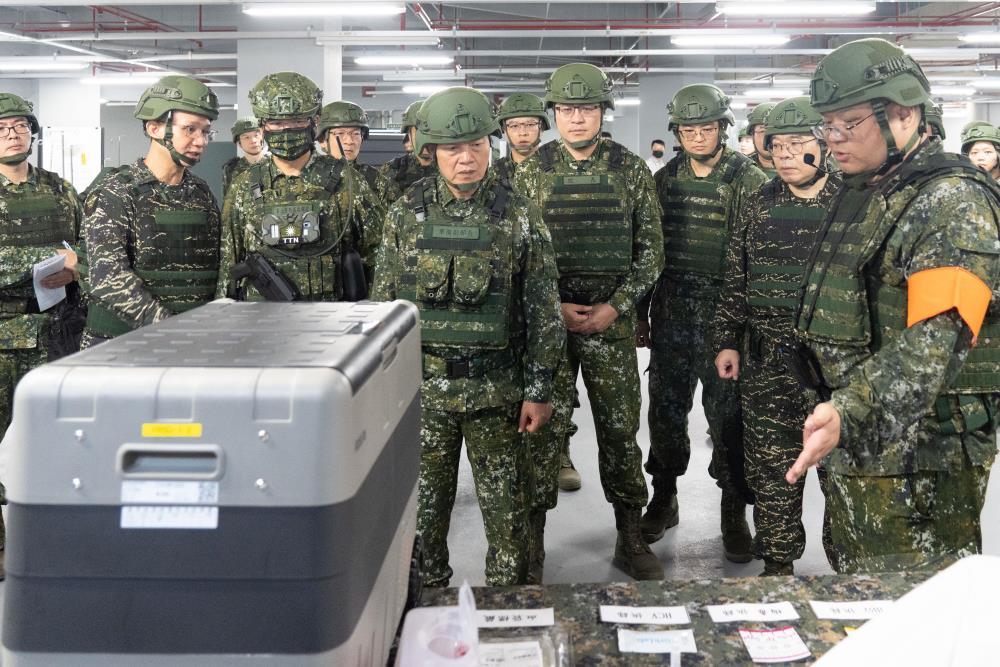
As the field training phase ofHan Kuang 42 Exercise continued, Vice Minister of National Defense General Chung Shu-ming visited the Taoyuan Armed Forces General Hospital today to inspect a “mass-casualty response exercise.” He was accompanied by Third Theater of Operations Commander Lieutenant General Lien Chih-wei, Director of the Army Logistics Command’s Medical Affairs Division Major General Wu Yu-chuan, Acting Deputy Director-General of the Medical Affairs Bureau Colonel Chen, and other officials.
Conducted as part of the exercise phase focusing on defense in depth and protracted operations, the scenario simulated the 584th Brigade suffering a large number of casualties during an engagement with enemy forces. After receiving Role 1 and Role 2 medical care and being processed through a casualty evacuation control point, the casualties were evacuated in sequence to the Taoyuan Armed Forces General Hospital. Upon receiving notification, the hospital immediately activated its emergency response mechanisms and converted its underground space into an alternate medical treatment facility.
During the inspection, Vice Minister Chung reviewed the establishment and operation of the underground medical facility, inter-unit communications mechanisms, procedures for requesting road access for casualty evacuation, use of the “Field Smart Medical Information System,” backup power, and the self-sustaining blood product supply capability.
Vice Minister Chung also reviewed wartime blood product resupply and transportation mechanisms. He reminded relevant units to plan carefully for potential wartime contingencies to ensure that blood products can reach points of care promptly and meet the treatment needs arising from mass-casualty incidents. Vice Minister Chung also provided guidance on the overall planning of uninterruptible power supplies, emergency generators, and the electricity required for medical equipment. These measures are intended to ensure that critical medical facilities and treatment operations can continue functioning if the external power supply is disrupted.
In addition, Vice Minister Chung commended the use of the “Field Smart Medical Information System.” He expressed hope that the system would provide real-time information on casualty movements, patient intake at medical stations, and the medical needs of military units, thereby improving information integration and the efficiency of resource allocation. He also instructed the theater commander to coordinate closely with the medical and logistics systems, assess wartime medical requirements, and establish a comprehensive support mechanism.