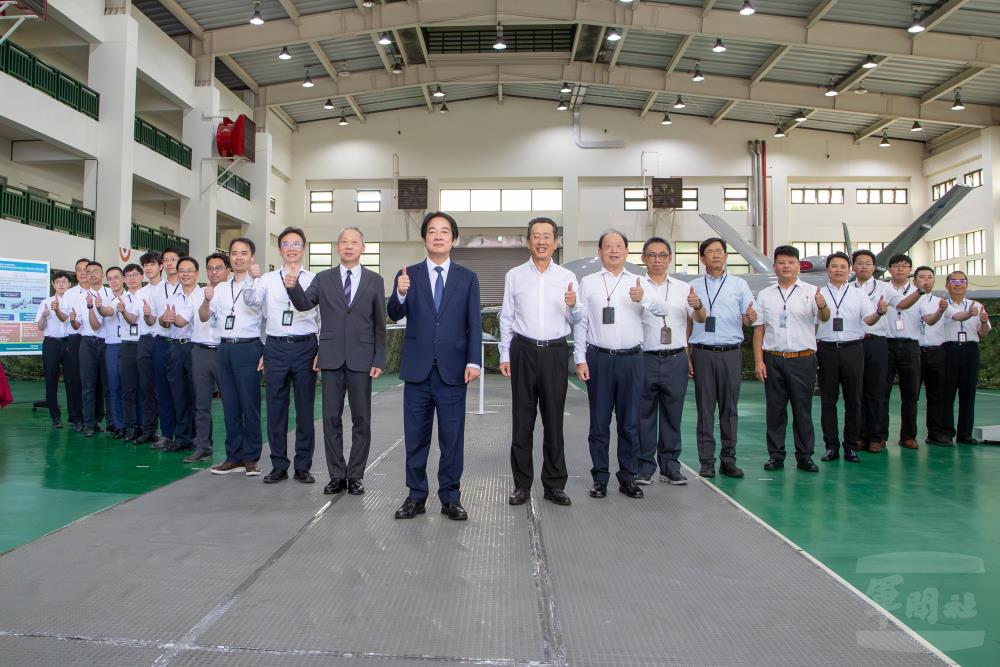
President Lai Ching-te today visited the Aeronautical Systems Research Division of the National Chung-Shan Institute of Science and Technology (NCSIST). He said that China has intensified its political and military intimidation of Taiwan, united-front infiltration within the country, and transnational repression in recent years. Taiwan must answer the international call for collective defense and burden-sharing. Describing drones as a representative weapon of asymmetric warfare, President Lai called on the Legislative Yuan to support the special defense budget and the development of a national drone offensive and defensive system. This would allow the relevant programs to be rapidly put in place, safeguarding national security and maintaining peace and stability in the Indo-Pacific.
Accompanied by National Security Council Secretary-General Joseph Wu, Minister of National Defense Wellington Koo Li-hsiung, NCSIST President Li Shih-chiang, and Aeronautical Systems Research Division General Director Chiou Chu-hsiang, President Lai inspected the progress of NCSIST’s drone development program this morning. He also received briefings on its anti-radiation unmanned attack system and various types of NCSIST-developed drones.
In his remarks, President Lai reiterated that China has increasingly subjected Taiwan to political and military intimidation, united-front infiltration, and transnational repression. To demonstrate Taiwan’s resolve to defend the nation, preserve stability across the Taiwan Strait, and maintain peace in the Indo-Pacific, Taiwan must respond to the international call for collective defense and burden-sharing.
President Lai said that the Ministry of National Defense had previously proposed an eight-year special budget totaling NT$1.25 trillion for legislative review. However, the Legislative Yuan approved only NT$780 billion, cutting NT$470 billion. The approved funding was insufficient even to cover arms procurement from the United States. The NT$470 billion cut from the proposal had been intended for international cooperation, commissioned projects, indigenous research and development, and the advancement of the defense industry. Most importantly, the entire budget for drone-related programs was removed.
President Lai noted that the Russia-Ukraine war, the Israel-Hamas conflict, and the ongoing hostilities between the United States and Iran had demonstrated the critical importance of drones on the battlefield. Drones could be considered the quintessential weapon of asymmetric warfare. The Executive Yuan had therefore not abandoned the initiative. President Lai thanked Minister Koo and his colleagues for proposing another special act on drones, with total funding of NT$210 billion. A further NT$200 billion to NT$300 billion would be allocated through a supplementary budget and next year’s budget to restore the NT$470 billion previously removed by the legislature. Regrettably, the opposition parties had still not supported drone development. Moreover, some drone legislation proposed by opposition parties would place the Ministry of Economic Affairs, rather than the Ministry of National Defense, in charge.
Citing Minister Koo’s remarks during legislative questioning, President Lai said, “The money for rice cannot be confused with the money for soy sauce.” He explained that the proposed funding was intended to procure the military drones required by the Ministry of National Defense. If the drone industry development legislation proposed by legislators were administered by the Ministry of Economic Affairs, its funding could be used only for commercial and civilian applications and would not meet Taiwan’s force development requirements.
President Lai emphasized that the Ministry of National Defense and the Ministry of Economic Affairs have different mandates and responsibilities. The Ministry of Economic Affairs is responsible for supporting industry by building the supply chain and helping manufacturers produce the drones required by the Ministry of National Defense. Furthermore, the Executive Yuan has already provided the Ministry of Economic Affairs with NT$44.2 billion under a six-year program to establish this supply chain. There is therefore no need for the Legislative Yuan to provide the Ministry with additional funding. The President expressed hope that the Legislative Yuan would support the nation and enable everyone in the Ministry of National Defense, from the Minister and military leaders to every individual service member, to continue fulfilling their duties.
President Lai said that he was deeply impressed by NCSIST’s research and development achievements. Taiwan’s drone technology is already keeping pace with international developments, with the National Security Council, Ministry of National Defense, Ocean Affairs Council, Ministry of the Interior, and other relevant Executive Yuan agencies all contributing to the effort. Through international exchanges, the Ministry of National Defense has also developed a comprehensive blueprint for drone operations. NCSIST, the Industrial Technology Research Institute, the Institute for Information Industry, and research institutions at universities are all in position, as is the Taiwan Excellence Drone International Business Opportunities Alliance (TEDIBOA). “In other words, everything is ready except the final impetus,” President Lai said. If the Legislative Yuan supports the Ministry of National Defense, the Executive Yuan, and the nation in building an integrated drone attack and defense system, the President said he was confident in assuring the public that the government would safeguard national security and preserve peace and stability in the Indo-Pacific.
President Lai acknowledged that competition and confrontation among political parties are inevitable. However, the national interest and the lives and property of the people must never be used as bargaining chips in political conflict. He said it was deeply disheartening to repeatedly see Minister Koo and his colleagues having to visit plenary sessions, legislative committees, and individual legislators’ offices to explain the proposals. The time and energy spent on these efforts could instead allow the Minister, commanders at every level, and service members to focus on training and maintaining combat effectiveness.
President Lai emphasized that he had come to NCSIST specifically to explain the matter to the public and seek support for the government’s determination to defend national security and protect peace and stability in the Indo-Pacific. The government is confident that once the Legislative Yuan approves the special defense budget, all the relevant programs can be rapidly put in place. President Lai stressed that the funding should be provided through a special budget rather than annual budgets, as force development and defense preparedness require stable, long-term government funding. Taiwan has also historically used special budgets to fund major defense development and preparedness programs. He called on the public to express its support and thereby encourage the opposition parties to do the same. He also urged parties across the political spectrum to jointly support national security and industrial development, demonstrating to the international community Taiwan’s resolve to defend itself.