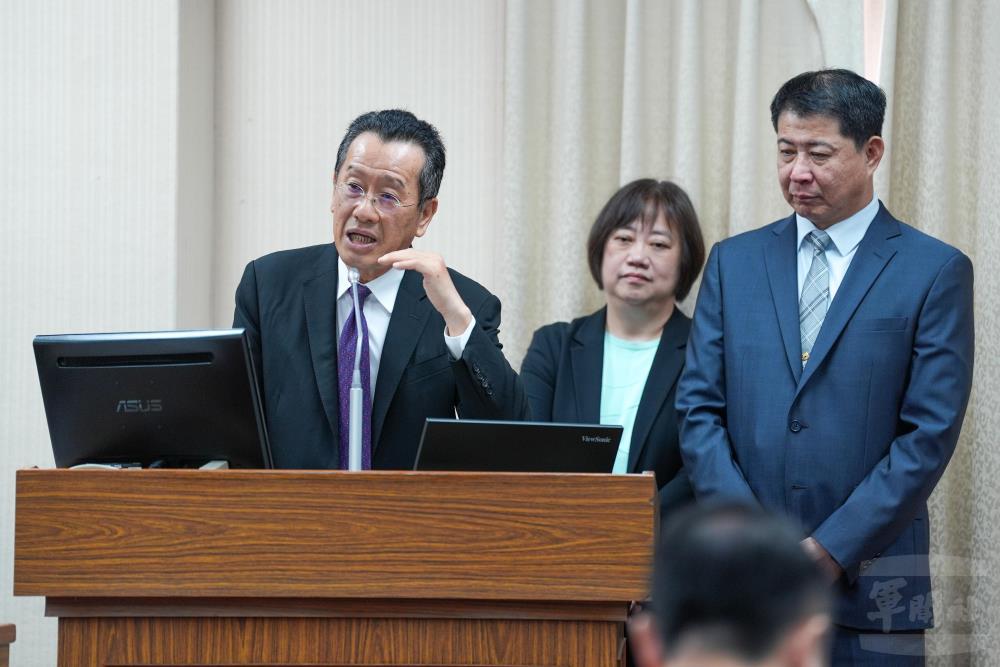
Amid growing public concern over the impact of Taiwan’s declining birth rate on defense personnel, Minister of National Defense Wellington Koo Li-Hsiung appeared today before the Legislative Yuan’s Foreign Affairs and National Defense Committee to present a special report entitled “Armed Forces Human Resources Policies and Future Response Plans amid the Impact of the Declining Birth Rate” and answer legislators’ questions.
Minister Koo began by noting that the declining birth rate has altered Taiwan’s demographic structure and reduced the number of workers entering the labor market. As a result, the Armed Forces face the dual challenges of a shrinking pool of young and working-age recruits and intensifying competition for talent from the private sector. To maintain a stable supply of personnel, the Ministry of National Defense has introduced a series of improvements in recent years covering troop management, service members’ benefits, and compensation. These measures are intended to enhance the service environment and sustain the Armed Forces’ combat capabilities. Lan Ching-ting, Director-General of the Ministry of Defense’s Department of Resource Planning, subsequently delivered a detailed report on the issue.
Director-General Lan explained that Taiwan’s population is aging rapidly. After falling below 100,000 in 2023, the number of draft-eligible men is projected to continue declining and reach approximately 77,000 by 2027. To meet personnel requirements, the Armed Forces currently operate a dual-track system comprising both volunteer and compulsory service. As of the end of 2025, personnel strength stood at 80% of authorized staffing levels, with volunteer personnel accounting for 77.3% and one-year conscripts for 2.7%.
Reviewing recent progress, Director-General Lan said the Ministry had introduced various incentives to improve recruitment and retention. These include adopting a more people-centered approach to personnel management, such as abolishing the requirement for service members to report in while on leave and permitting independent overseas travel. The Ministry has also implemented the Xing’an Project to accelerate the renovation of aging barracks and relaxed eligibility requirements for enlistment. The Ministry has also actively sought improvements to military pay and benefits. In 2025, five duty-related allowances, including the Volunteer Service Duty Allowance, were increased. In 2026, the Executive Yuan approved the inclusion of drone units among those eligible for the Combat Unit Allowance. These policies have produced tangible results. Both the number of volunteer personnel and the retention rate, which rose by 5.2%, increased in 2025 compared with 2024. As of June 2026, the number of volunteer personnel had also grown by more than 5,000 year on year.
Turning to future plans, Director-General Lan emphasized that the Armed Forces would pursue development centered on “replacing manpower with technology” and “replacing conventional troop strength with firepower.” The military will actively procure unmanned systems and intelligent systems while incorporating key technologies such as artificial intelligence, transforming traditionally manpower-intensive units into modern, technology-enabled forces. The Armed Forces will also continue expanding opportunities for women. Women currently account for approximately 16.6% of military personnel, and further efforts will be made to foster a supportive workplace that attracts more women to military careers. In addition, the Ministry will continue reviewing duty-related allowances and plans to make conscripts serving in combat units eligible for the monthly Combat Unit Allowance, further strengthening Taiwan’s defense personnel base.