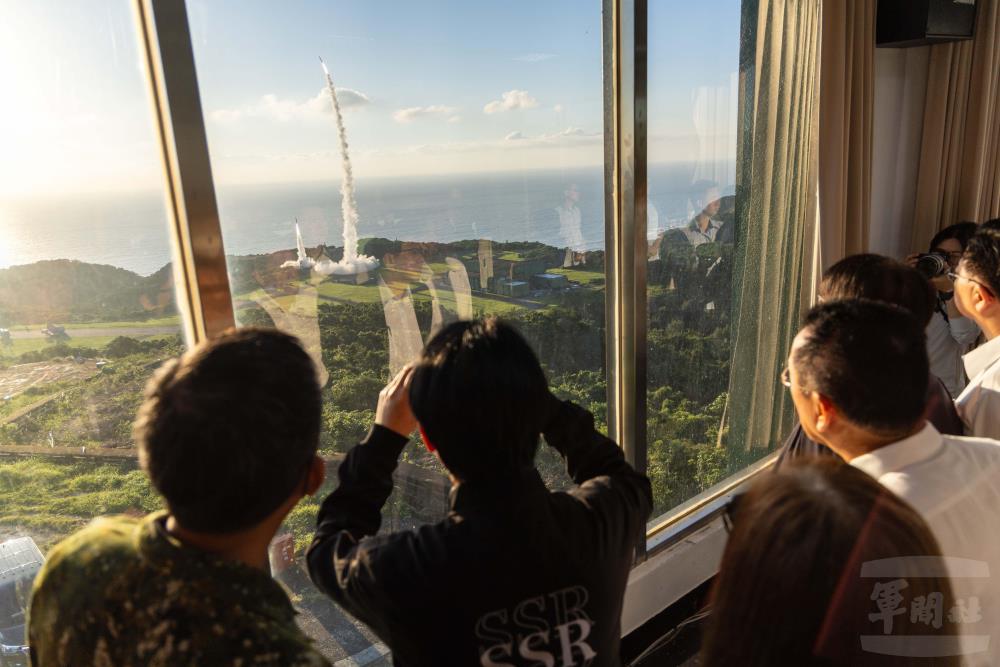
President Lai Ching-te recently traveled to Pingtung to observe the “2026 Joint Precision Missile-Firing Exercise” and extend Mid-Autumn Festival greetings to service members. After reviewing the exercise firsthand, President Lai commended the Armed Forces for demonstrating joint operational capabilities and the results of rigorous training through realistic exercises. He emphasized that the government will continue supporting enhanced training and equipment modernization to strengthen combat readiness and safeguard national security.
Upon arrival, President Lai first inspected the safety control center and observed a live-fire exercise. He also presented meal supplement funds in recognition of the participating service members’ hard work. In his remarks, President Lai thanked all personnel and supporting units involved in the exercise. He stated that whether conducting live-fire missions or providing logistical and technical support, the professionalism and dedication demonstrated by service members were essential to the successful completion of the mission.
President Lai explained that precision missile-firing exercises are vital for evaluating weapon effectiveness, training results, and the joint operational capabilities of the Army, Navy, and Air Force. Every stage, from exercise planning and equipment preparation to firing operations and logistical support, must be executed with precision. During the three-day exercise, participating units conducted joint air defense, counterstrike operations, naval-air coordination, littoral strikes, and coastal defense missions in accordance with the Taiwan-Penghu Defense Operations Plan. All exercise objectives were successfully achieved, demonstrating the results of the Armed Forces’ rigorous day-to-day training.
President Lai noted that the exercise was conducted under realistic combat conditions, thoroughly testing the command-and-control and coordinated operational capabilities of all service branches. In particular, several types of attack drones were incorporated into a joint operational exercise for the first time. The coordinated employment of unmanned systems and conventional weapons reflects the evolving nature of modern warfare and will accelerate improvements in the Armed Forces’ overall combat capabilities. President Lai added that the exercise demonstrated to the people of Taiwan and the international community that the Armed Forces have both the confidence and capability to defend national sovereignty and fulfill their responsibility to maintain regional peace and stability.
The President stated that peace does not come easily and must be safeguarded through firm resolve and sufficient strength. Every realistic exercise further enhances combat capabilities and readiness, strengthening the nation’s ability to defend peace. The professionalism and discipline displayed by service members in carrying out their missions provide the strongest foundation for national security and underpin the people’s trust in the Armed Forces.
President Lai emphasized that the government will continue supporting the Armed Forces in enhancing training and modernizing equipment while also improving service members’ working conditions and welfare. He urged commanders at all levels to lead their units effectively and take good care of their personnel, enabling service members to focus on training and perform their duties with peace of mind. The President also encouraged all service members to continue honing their combat skills, remain steadfast at their posts, and complete every combat-readiness mission to jointly safeguard national security and protect Taiwan’s democratic and free way of life.
President Lai was accompanied by Secretary-General to the President Pan Men-an; National Security Council Secretary-General Joseph Wu; Minister of National Defense Wellington Koo Li-hsiung; Ocean Affairs Council Minister Kuan Bi-ling; National Security Council Advisor Liu Te-chin; National Security Council Deputy Secretary-General Lii Wen; Chief of Army General Lu Kun-hsiu; Chief of Navy Admiral Chiang Cheng-kuo; Deputy Chief of Navy Vice Admiral Hsu Chin-teng; Deputy Chief of Air Force Lieutenant General Wang Te-yang; and National Chung-Shan Institute of Science and Technology President Li Shih-chiang.