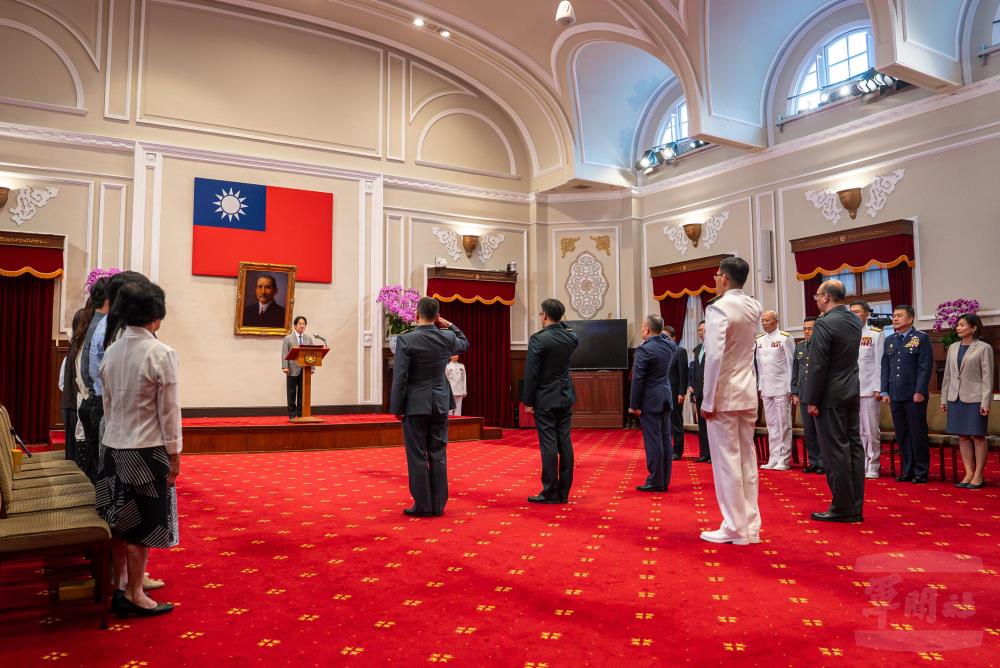
This afternoon, President Lai Ching-te presided over the November 2026 General Officer Promotion Ceremony. He expressed hope that the general officers will continue to deepen their professional knowledge and skills, uphold professionalism, demonstrate a strong sense of responsibility, put the team first, and make even greater contributions to enhancing the combat capabilities of the ROC Armed Forces. He emphasized that in the face of authoritarian expansionism and gray-zone threats, the ROC Armed Forces must continue advancing toward "new training, new thinking, new equipment, and new technology," leveraging technology to safeguard democracy and using strength to defend peace, while leading their units in a "people-centered" manner to build modernized ROC Armed Forces that are stronger and more resilient.
The ceremony was held in the afternoon at the Presidential Office and was attended by Secretary-General to the President Pan Men-an; National Security Council Secretary-General Joseph Wu Jaushieh; Minister of National Defense Wellington Koo Li-hsiung; Chief of the General Staff Admiral Mei Chia-shu; Chief of Army General Lu Kun-xiu; Chief of Navy Admiral Chiang Cheng-kuo; and Chief of Air Force General Cheng Jung-feng, among others.
In his remarks, President Lai first extended his heartfelt congratulations and gratitude to the five generals and their family members, stating that a promotion in rank signifies national recognition and entails greater responsibilities.
President Lai offered special congratulations to General Wu Chih-wei on his promotion to lieutenant general, noting that General Wu previously served as Director of the Ministry of National Defense Situation Center, Commander of the Air Force 2nd Tactical Fighter Wing, and Chief of Staff of the Air Force Combat Command. From managing frontline units, to maintaining situational awareness at the Ministry of National Defense, to serving in the Air Force's operational command system, he has gained extensive professional experience across different levels of command. President Lai expressed hope that General Wu will continue to apply his wide-ranging expertise in his new post and strengthen command and control, situational assessment, and cross-unit coordination capabilities, to enable the Air Force to execute its readiness missions with greater precision and efficiency and safeguard national airspace.
President Lai also congratulated Chiang Wei-hsiang, Lee Ming-chin, Yu Tsung-hsueh, and Liu Hsi-wan on their promotion to major general, stating that the four generals each have well-rounded experience and outstanding performance in their respective fields of logistics support and operational readiness, chemical, biological, radiological, and nuclear (CBRN) defense, procurement contract management, and amphibious operations. They have been appointed, respectively, as Commander of the Army 5th Regional Support Command, Director of the Chemical Corps Division of the Army Command Headquarters, Deputy Director of the National Defense Procurement Office, and Commander of the Marine Corps 99th Brigade, where they will take on more critical missions. Whether in frontline command and protection, or in the logistics support, equipment maintenance and defense procurement that underpin combat power, every specialty is an indispensable part of overall combat capability.
President Lai expressed hope that the newly promoted general officers will continue to deepen their professional knowledge and skills, build their careers on professionalism, hold themselves to a high sense of responsibility, keep the team foremost in mind, and make even greater contributions to enhancing the combat capabilities of the ROC Armed Forces. In the face of authoritarian expansionism and gray-zone harassment, the ROC Armed Forces must continue advancing toward "new training, new thinking, new equipment, and new technology," and leaders at all levels must turn force development objectives into concrete daily actions within their units.
President Lai emphasized that the higher one's position, the more one must be able to think from an overall perspective, understand the needs of other units, and take the initiative to coordinate and provide mutual support. Therefore, unit training must start from the overall defense mission, enabling officers and enlisted personnel from different services and specialties to practice joint coordination develop operational cohesion during training and exercises. Leaders must track identified deficiencies and implement corrective measures and ensure that the corrections produce real results in subsequent training, so that every exercise yields tangible gains.
Speaking on the use of technology, President Lai stated that the ROC Armed Forces must make good use of technology to safeguard democracy and use strength to defend peace, and, with an asymmetric warfare mindset, turn unmanned systems and emerging technologies into their far-seeing eyes and innovative vanguard. While introducing new technologies and new equipment, they must also ensure logistics and supply, equipment readiness, the maintenance of command, control, and communications, and cybersecurity protection, giving full consideration to the personnel workload at the unit level.
President Lai further stated that no matter how advanced equipment and technology may be, personnel are ultimately essential to translating these capabilities into combat effectiveness. He encouraged the senior leaders in attendance to lead their units in a "people-centered" manner, attaching importance to the training needs, welfare, and career development of rank-and-file personnel, fostering a leadership culture that is fair and professional and emphasizes leading by example, and building a stronger, more resilient, and modernized ROC Armed Forces.
Finally, President Lai once again thanked the family members in attendance, noting that military duties often affect family life and that families devote much effort in their daily lives to supporting the officers and enlisted personnel of the ROC Armed Forces, so today's honor also belongs to each and every one of the family members present. He stated that the government will continue to give the ROC Armed Forces more comprehensive support, and expressed his hope that the generals will carry the honor and responsibility of their promotion, respond to the public's trust with solid performance, and lead their personnel in jointly safeguarding the nation.