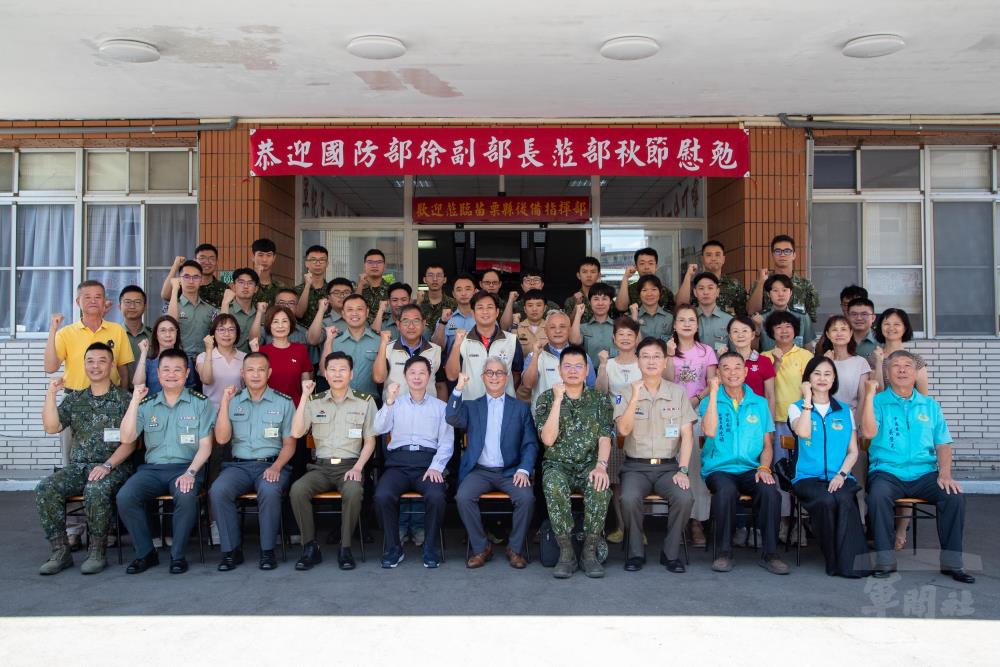
Ahead of the Mid-Autumn Festival, Vice Minister of National Defense Hsu Szu-chien visited the Miaoli area today on behalf of Minister of National Defense Wellington Koo Li-hsiung. He visited the Miaoli County Reserve Command and Miaoli Military Police to learn about their mission execution. Vice Minister Hsu commended service members and reserve advisory cadres for remaining steadfast at their posts and dedicated themselves to their duties, and extended early wishes for a happy Mid-Autumn Festival.
Accompanied by Fifth Theater of Operations Deputy Commander Major General Ma Ji-rui, All-out Defense Mobilization Agency Deputy Director-General Liu Tai-yi, Military Police 203rd Command Deputy Commander Colonel Tseng, and other officials, Vice Minister Hsu received mission briefings at the two units. He reviewed their reserve mobilization readiness, military-civilian coordination, and military police operations. He also spoke with service members and reserve advisory cadres and asked about their work and daily lives.
Vice Minister Hsu said this year’s Urban Resilience Exercise incorporated wartime disaster scenarios for the first time. The purpose of the exercise was to identify problems through practical validation and make continuous improvement. Units should continually review their personnel and materiel requirements based on the exercise results. In particular, they should realistically assess the vehicles, machinery, and other resources required for such missions as evacuating civilians from disaster areas, transporting critical supplies, and protecting critical infrastructure. Any deficiencies identified should be addressed promptly so that readiness preparations more closely reflect actual requirements.
Vice Minister Hsu emphasized that reserve advisory cadres serve as an important communication bridge between the military, local governments, and civil society. Effective coordination mechanisms should be established during peacetime and repeatedly tested and refined through training and exercises. Communications planning should also account for the possibility that normal communications may be disrupted during wartime. Units should establish multiple backup communication methods and ensure that personnel are familiar with operating the relevant systems. Reserve advisory cadres have long-established ties within their communities and play an important role in connecting the Armed Forces with the public. Vice Minister Hsu encouraged them to continue drawing on their local knowledge and ability to coordinate resources to support military operations and enhance military-civilian integration.
In the afternoon, Vice Minister Hsu visited the Miaoli Military Police to review its mission execution and combat-readiness preparations. He emphasized that joint transportation operations involve troop movements, road access, and coordination with local authorities and must therefore be incorporated into mission planning. Units should strengthen coordination and conduct drills during peacetime for potential contingencies they may face, identifying problems early and making continual adjustments to ensure the successful execution of all wartime missions.