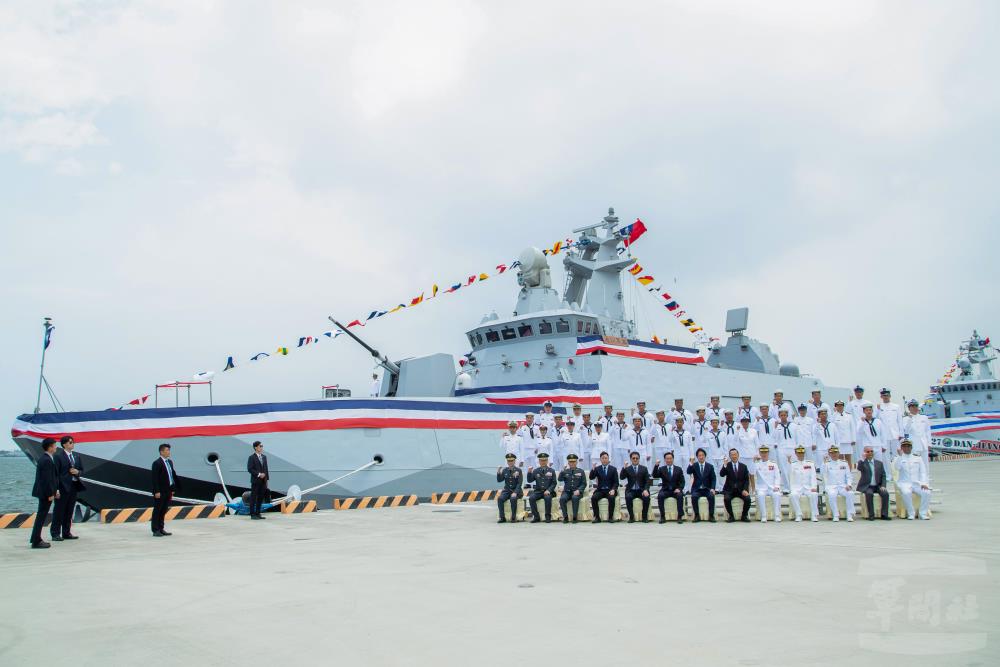
President Lai Ching-te presided over the “commissioning ceremony for the ROCS Dan Jiang” in Kaohsiung this morning. He said the vessel’s commissioning not only marked further progress toward “indigenous naval shipbuilding,” but also demonstrated the Navy’s unwavering resolve to defend Taiwan’s waters and safeguard national security. The President emphasized that Taiwan would continue advancing defense self-reliance through indigenous naval shipbuilding, indigenous military aircraft production, and drone development. By building strength, Taiwan can create effective deterrence and secure peace. He also called on parties across the political spectrum to support defense development and continue strengthening national security and defense capabilities.
President Lai presided over the ceremony accompanied by National Security Council Secretary-General Joseph Wu, Minister of National Defense Wellington Koo, National Security Council Advisor Liu Te-chin, National Security Council Deputy Secretary-General Lii Wen, Chief of Navy, Admiral Chiang Cheng-kuo, and other officials. Upon arriving at the venue, the President was accorded full military honors with a 21-gun salute. During the ceremony, President Lai formally issued the commissioning order for the ROCS Dan Jiang. He then presented the ship’s colors and official seal, received a model of the vessel, and reviewed the troops.
In his remarks, President Lai said it was a great honor to preside over the commissioning ceremony. On behalf of the nation, he thanked Minister Koo, Admiral Chiang, all Navy personnel, the research and development team and the shipbuilding team, and every member of the industrial supply chain for overcoming numerous challenges. Their efforts had not only brought the ROCS Dan Jiang into service, but also advanced Taiwan’s goal of “indigenous naval shipbuilding.” The three warships moored before the ceremony illustrated the development of the Tuo Chiang-class corvette, the President said. Following the design validation of the prototype ROCS Tuo Chiang, the first batch of production vessels, beginning with the ROCS Ta Chiang, entered service successively. The ROCS Dan Jiang is now the lead vessel of the second production batch. All 12 vessels are expected to be delivered by the end of this year and will jointly defend Taiwan’s waters and safeguard national security.
President Lai said the commissioning of the ROCS Dan Jiang held three important meanings. First, it demonstrated the realization of Taiwan’s “indigenous naval shipbuilding” goals. Taiwan can now independently develop, design, construct, and integrate naval systems according to the operational requirements in the Taiwan Strait. It can also perform maintenance and quality improvements, ensuring operational advantage under wartime conditions. Second, the commissioning represented the Navy’s firm determination to defend Taiwan’s waters and protect the nation. As China’s military threats and gray-zone harassment at sea continue to intensify, the commissioning and achievements of the Tuo Chiang-class vessels demonstrate to the public the unity and determination of Navy personnel to defend Taiwan’s waters and safeguard national security. Third, it demonstrated Taiwan’s national security policy of achieving peace through strength by maintaining effective deterrence.
President Lai emphasized that peace is priceless and that there are no winners in war. Peace cannot be secured merely by signing an agreement, relying on an aggressor’s goodwill, or accepting an aggressor’s demands. Taiwan firmly believes in securing peace through strength. For decades, the Armed Forces have developed their capabilities and maintained combat readiness with this objective in mind. The President called on the public and legislators from all political parties to support this approach.
To build the strength required for effective deterrence and peace, the Ministry of National Defense previously proposed an eight-year special budget totaling NT$1.25 trillion. Regrettably, the Legislative Yuan did not approve the proposal in full, cutting NT$470 billion intended for defense self-reliance, international cooperation, commissioned projects, drone development, and other programs. President Lai stressed that strengthening Taiwan’s defense capabilities, procuring military equipment from abroad, and pursuing international cooperation are all important. Defense self-reliance, however, is even more critical. Indigenous naval shipbuilding, indigenous military aircraft production, and the development of a drone industry that can generate combat capabilities all advance this objective. The President therefore called on the Legislative Yuan to support the special budget proposed by the Ministry of National Defense. He emphasized that the Ministry of National Defense is both the competent authority and the end user and that responsibility for the programs should not be assigned to another ministry. The funding should also be provided through a special budget, allowing defense development and combat readiness programs to proceed steadily over multiple years. He expressed hope that both the public and the Legislative Yuan would support the proposal.
With the ROCS Dan Jiang now officially commissioned, President Lai encouraged everyone aboard, from the commanding officer to every crew member, to maintain rigorous combat readiness training in peacetime. When called upon, they must be ready to employ the vessel’s combat capabilities, defend Taiwan’s waters, safeguard national security, and protect the lives and property of the people. The Armed Forces have a proud tradition, he said, and every service member should make full use of their abilities in carrying it forward.
President Lai noted that this year marks the 30th anniversary of Taiwan’s first direct presidential election. In 1996, the Armed Forces stood on the front line to safeguard national security, enabling citizens to enter polling stations without fear and cast their ballots in Taiwan’s first presidential election. That election cemented Taiwan’s democratic identity and showed the international community that the people of Taiwan are the masters of their country, that their destiny rests in their own hands, and that no one else has the right to control it. This year also marks the 39th year since martial law was lifted. Taiwan once endured one of the longest periods of martial law in modern history, lasting 38 years. During that time, people were denied freedom and human rights, and some suffered persecution. With the support of the public and through the efforts of the democracy movement, martial law was ultimately lifted by the power of the people.
President Lai said this was the first year in which Taiwan’s period of democratization had lasted longer than its period under martial law, giving the occasion profound significance. He therefore took the commissioning of the ROCS Dan Jiang as an opportunity to remind those present that all services of the Armed Forces and every service member have stood on the front line whenever the nation needed them, safeguarding national security and defending democracy. At this critical moment, he called on the Army, Navy, and Air Force to remain united, uphold their proud tradition of force development and combat readiness, and continue standing on the front line. Their service enables the people of Taiwan to enjoy democracy, freedom, and human rights while allowing the economy to continue flourishing. In closing, President Lai once again thanked all personnel on behalf of the people of Taiwan and encouraged everyone to continue working together.
After the ceremony, President Lai posed for photographs with service members and presented an additional meal allowance in recognition of their hard work. He then boarded the ROCS Dan Jiang for an inspection. From the foredeck, he observed a maneuver demonstration by the ROCS Xu Jiang and Kuang Hua VI-class missile boats and waved to their crews.