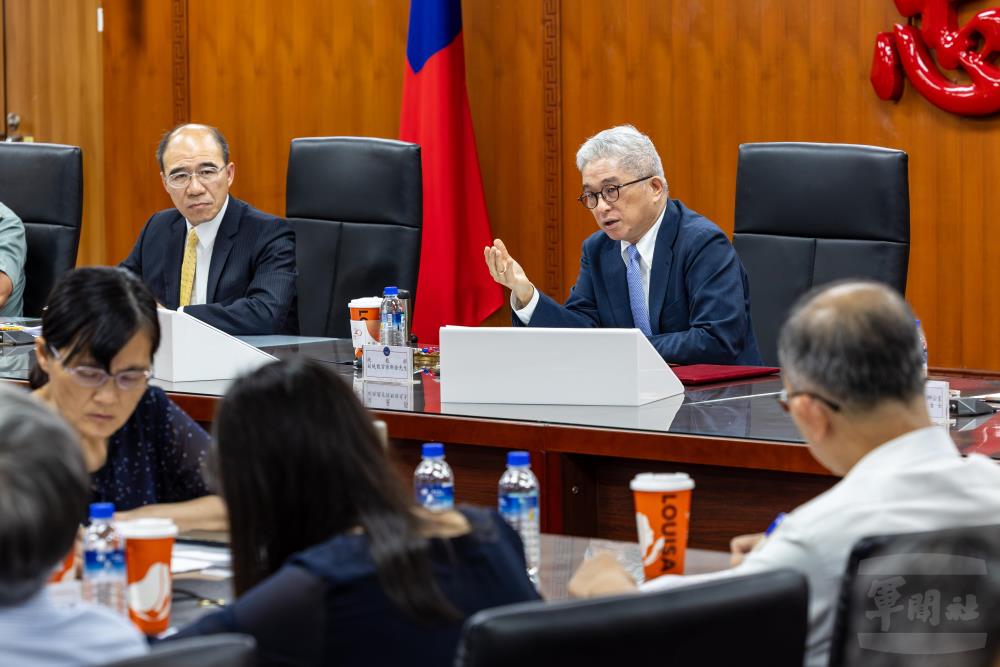
Vice Minister of National Defense Hsu Szu-chien presided over the “2026 Urban Resilience Exercise Review Meeting” at the Armed Forces Reserve Command today. All-out Defense Mobilization Agency Director-General Lieutenant General Liao Chien-hsing, Executive Yuan Office of Disaster Management Director Wang Yi-wen, Armed Forces Reserve Command Commander Lieutenant General Yu Wen-chen, and representatives of central government ministries and agencies, local governments, and units of the ROC Armed Forces attended the meeting to review the conduct of this year’s exercise.
The meeting opened with the recognition of outstanding units. On behalf of Minister of National Defense Wellington Koo Li-hsiung, Vice Minister Hsu presented certificates of merit to the units that had performed outstandingly in the exercise, acknowledging their efforts and contributions to exercise preparations and encouraging them to continue strengthening civil-military integration mechanisms and enhancing whole-of-society defense resilience.
In his remarks, Vice Minister Hsu said that this year, for the first time, severe wartime scenarios were incorporated into the Urban Resilience Exercise. Through practical drills, existing plans, response mechanisms, and preparedness efforts were examined in order to identify problems, review their causes, and translate the lessons learned into concrete improvement measures that enhance wartime response capabilities.
Vice Minister Hsu noted that next year’s Urban Resilience Exercise will be further integrated with the Han Kuang Exercise. In line with operational missions and the evolving battlefield situation, it will validate local governments’ capabilities in evacuation, combat casualty care, transportation, strategic communication, and support for Armed Forces operations, thereby strengthening the joint response mechanism among the central government, local governments, and the Armed Forces.
Vice Minister Hsu emphasized that in wartime, the county- and city-level Local Joint Emergency Operations Centers (LJEOCs) must operate under the command of the Central Joint Emergency Operations Center (CJEOC), giving priority to supporting Armed Forces operations while also attending to tasks such as caring for the public and maintaining the functioning of local governments. All units should clarify their responsibilities and coordination procedures to ensure that military and civilian resources can be effectively integrated in wartime.
Vice Minister Hsu said that the Armed Forces Reserve Command plans to hold a demonstration of how the “Mobilization and Civilian Resources Coordination Group”operates, and that in March next year selected counties and cities will conduct demonstration drills on civil-military integration, progressively establishing standard operating procedures for coordination between the military and civilian sectors. He also reminded local governments to take a thorough inventory of the resources they would need in wartime and of their existing capacities, so as to avoid duplicating the Armed Forces’ requirements and to improve the effectiveness of civil-military coordination and resource allocation.
Vice Minister Hsu further noted that operator training on the Emergency Management Information Cloud (EMIC) system and the Team Awareness Kit (TAK) should be strengthened to improve the ability of the central government, local governments, and the Armed Forces to maintain a shared picture of response information. Problems identified during the exercise should be incorporated into follow-on preparedness and improvement efforts, and the results of those improvements should be continually verified through exercises and training, so as to ensure that all wartime response mechanisms function effectively and that national security is jointly safeguarded.