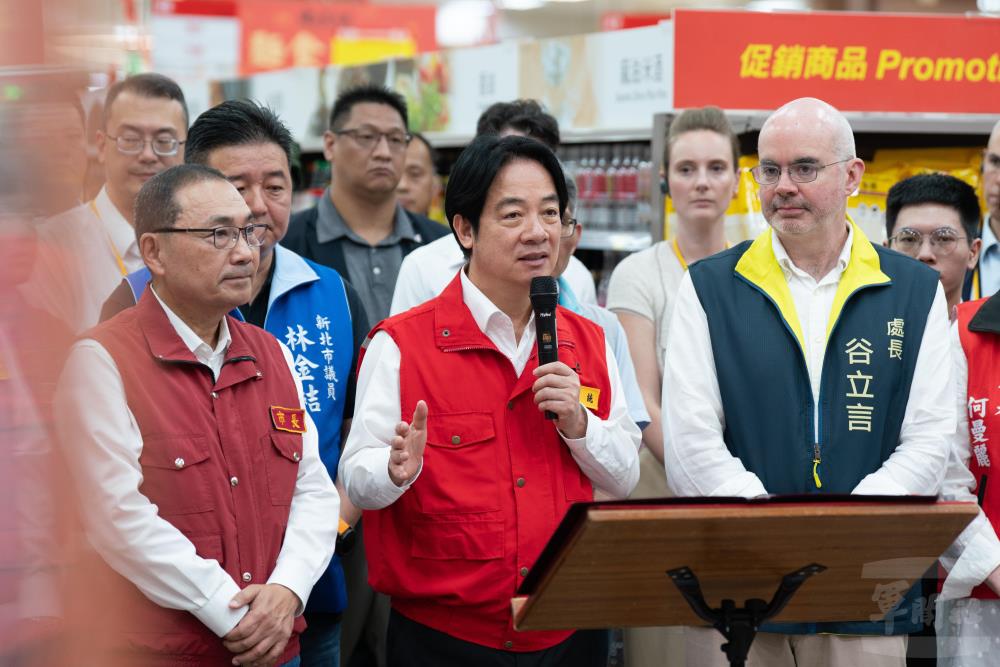
President Lai Ching-te today inspected the New Taipei City 2026 Urban Resilience (All-out Defense Mobilization) Exercise. Exercise events included operations at the Joint Emergency Operations Center (JEOC), medical load reduction and underground relocation at Shuang Ho Hospital, and the distribution and sale of essential supplies. The President expressed hope that cooperation between the central and local governments and collaboration between the public and private sectors would continue strengthening societal resilience, enabling the government to remain operational and minimizing disruption to people’s lives during emergencies.
In his remarks, President Lai noted that Taiwan experiences typhoons every year and may also be struck by earthquakes every few years. In addition to building up the Armed Forces, preparing for war, and safeguarding national security, the Armed Forces has long participated in disaster relief and helped maintain social stability. The Armed Forces regard disaster response as an integral part of force development and combat readiness. Local governments also conduct annual societal resilience exercises in preparation for typhoons, earthquakes, and other disasters. These exercises were formerly known as Wan An and Min An Exercises.
President Lai said that after taking office, he established the “Whole-of-Society Defense Resilience Committee” under the Presidential Office to advance societal resilience. He also combined the Wan An and Min An Exercises conducted by local governments into the Urban Resilience Exercise. This year, the exercise was extended from one day to two and conducted in coordination with the Armed Forces’ annual Han Kuang Exercise. Under a common scenario, the Armed Forces conduct military exercises as the first line of defense while local governments carry out whole-of-society defense resilience exercises. The objective is for the Armed Forces to safeguard national security while local governments and civil society organizations work together to maintain social stability, minimizing the impact on society in the event of either natural disasters or geopolitical conflicts.
The President said he had specifically chosen to inspect the whole-of-society defense resilience exercise in New Taipei City this year. His first stop was the Joint Emergency Operations Center, followed by an inspection of emergency medical preparedness and then a distribution point for essential supplies. He thanked Mayor Hou Yu-ih and the city government team for their thorough preparations, noting that cooperation between the central and local governments had proven highly effective.
President Lai noted that the distribution system he inspected earlier included both government-operated distribution points and participating private retailers, creating a dual-track arrangement. A smart information system has also been established, and exercises continue to address a variety of potential scenarios. He described these achievements as highly commendable.
The President said that through collective efforts, central-local cooperation, and public-private collaboration, Taiwan can continue strengthening its societal resilience. When an emergency occurs, greater resilience will enable the government to maintain its operations while reducing the impact on people’s daily lives.
President Lai also referred to the air defense exercise conducted today from 2:30 to 3:00 p.m. In cities where the exercise was conducted, mobile communications were affected and data speeds were reduced during the exercise, while travel and movement were also somewhat disrupted. He asked the public for its understanding and support, emphasizing that the exercise was necessary. “Every exercise makes us more resilient. Greater resilience brings greater stability when an emergency occurs and reduces the impact on our lives,” the President said.
President Lai thanked the National Security Council and the ministries and agencies of the Executive Yuan for their efforts. He also noted that representatives of foreign missions in Taiwan had participated in the exercise and offered their observations, demonstrating the international community’s strong interest in Taiwan’s security and peace and stability across the Taiwan Strait. “The virtuous are never alone; they always have neighbors,” the President said. In the face of shifting regional geopolitics, Taiwan is not confronting these challenges alone, but alongside an international community that shares its concerns. Nevertheless, Taiwan must not neglect its own preparations or simply rely on others. Citing Mayor Hou’s remarks, President Lai said, “We need not fear a century without incident, but we must fear even one day without preparation.” By embracing this principle and preparing thoroughly, Taiwan will be ready for any eventuality. The more comprehensive its preparations, the better positioned it will be to prevent crises from occurring.
Also attending the exercise were New Taipei City Mayor Hou Yu-ih , who also served as Commander of the New Taipei City Joint Emergency Operations Center; National Security Council Secretary-General Joseph Wu; National Security Council Advisor Liu Te-chin; Deputy Secretary-General Lin Fei-fan; Minister without Portfolio Chi Lien-cheng; Minister of the Interior Liu Shyh-fang; Minister of Foreign Affairs Lin Chia-lung; Minister of National Defense Wellington Koo Li-hsiung; Minister of Health and Welfare Shih Chung-liang; Vice Minister of Economic Affairs Lai Chien-hsin; Deputy Minister of the Interior Ma Shih-yuan; All-out Defense Mobilization Agency Director-General Lieutenant General Liao Chien-hsing; American Institute in Taiwan Director Raymond Greene; Canadian Trade Office in Taipei Executive Director Marie-Louise Hannan; Israel Economic and Cultural Office in Taipei Representative Israel Strulov; and representatives of other foreign missions in Taiwan.