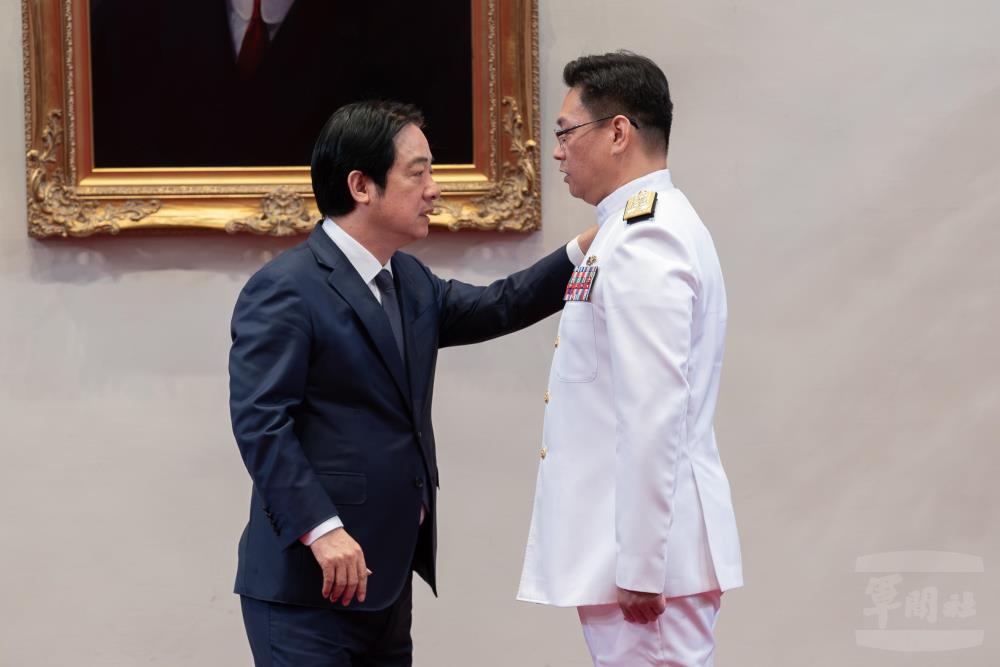
President Lai Ching-te presided over the October 2026 Flag Officer Promotion and Rank Conferral Ceremony this morning. He stated that the Armed Forces and Coast Guard must cooperate more closely to address the rapidly changing maritime environment by sharing maritime intelligence, ensuring stable command and communications, and strengthening maritime defense capabilities. President Lai also encouraged commanders at all levels to keep abreast of developments on battlefields worldwide and incorporate these lessons into unit readiness and training, thereby further strengthening overall combat capabilities.
The ceremony was held at the Presidential Office. Those attending included Secretary-General to the President Pan Men-an; Minister of National Defense Wellington Koo Li-hsiung; Chief of the General Staff Admiral Mei Chia-shu; Ocean Affairs Council Minister Kuan Bi-ling; and Chief of Navy Admiral Chiang Cheng-kuo.
In his remarks, President Lai stated that promotion to general officer represents an important milestone in a military career and signifies an even greater responsibility entrusted by the nation. On behalf of the country, he congratulated the two officers promoted this month and thanked their family members for their support.
President Lai noted that newly promoted Vice Admiral Yuan Sheng-hua has served as director of the Strategic Analysis Division under the Ministry of National Defense’s Department of Strategic Planning, commander of the Navy’s 192nd Fleet, and director of the Training and Readiness Division at Navy Command Headquarters. His extensive experience has given him an in-depth understanding of naval strategic planning, operational readiness, and training. Following his promotion, Vice Admiral Yuan has been transferred from his position as deputy chief of staff at Navy Command Headquarters to serve as deputy director-general of the Coast Guard Administration. President Lai expressed hope that Vice Admiral Yuan would draw on his experience to promote coordination between the Navy and Coast Guard, strengthen maritime intelligence sharing, and ensure close integration between maritime surveillance and reconnaissance and emergency response, enabling both organizations to jointly safeguard the nation’s maritime territory.
President Lai also noted that newly promoted Rear Admiral Chen Wei-chih possesses extensive expertise in the maintenance of naval weapons, equipment, and combat systems, as well as professional technical and systems-integration capabilities. Following his promotion, Rear Admiral Chen will return to the Navy’s Combat Systems Factory as its director. The factory maintains critical equipment, including torpedoes and missiles, and provides essential support for the Navy’s combat capabilities. As next-generation naval vessels continue entering service, President Lai encouraged Rear Admiral Chen to enhance weapons systems integration, leverage emerging technologies to strengthen indigenous maintenance capabilities, and ensure that every item of equipment can perform effectively when most needed.
President Lai stated that recent international developments demonstrate the increasing pace of change on modern battlefields. Gray-zone activities may occur simultaneously with cyberattacks and disinformation, while the use of artificial intelligence and unmanned systems has accelerated tactical adaptation and decision-making. These challenges, he said, underscore the need for combat capabilities that can withstand prolonged attrition. Even the most advanced equipment requires reliable maintenance capacity and skilled personnel to remain operational.
President Lai emphasized that the Armed Forces and Coast Guard must cooperate more closely to respond to Taiwan’s rapidly changing maritime environment. The two organizations must share maritime intelligence and ensure that command and communications remain stable under all circumstances. He expressed confidence that Vice Admiral Yuan and Rear Admiral Chen would apply their expertise in their new positions and help strengthen Taiwan’s maritime defense capabilities.
President Lai also encouraged commanders at all levels to keep abreast of new developments on battlefields worldwide and incorporate them into unit readiness and training. Command and communications systems, logistics, and equipment must be repeatedly tested through exercises. He added that leaders must understand the problems service members encounter during training and take concrete steps to resolve them. Only when every service member clearly understands the mission and is familiar with emergency response procedures can units operate steadily under pressure and build stronger overall combat capabilities.
In closing, President Lai thanked the family members in attendance for their longstanding understanding and support, which have enabled the promoted officers to devote themselves fully to their duties. “The honor of today’s promotions also belongs to every family member,” he said. President Lai expressed hope that the people of Taiwan would continue working together to safeguard national security and the stability of people’s lives.