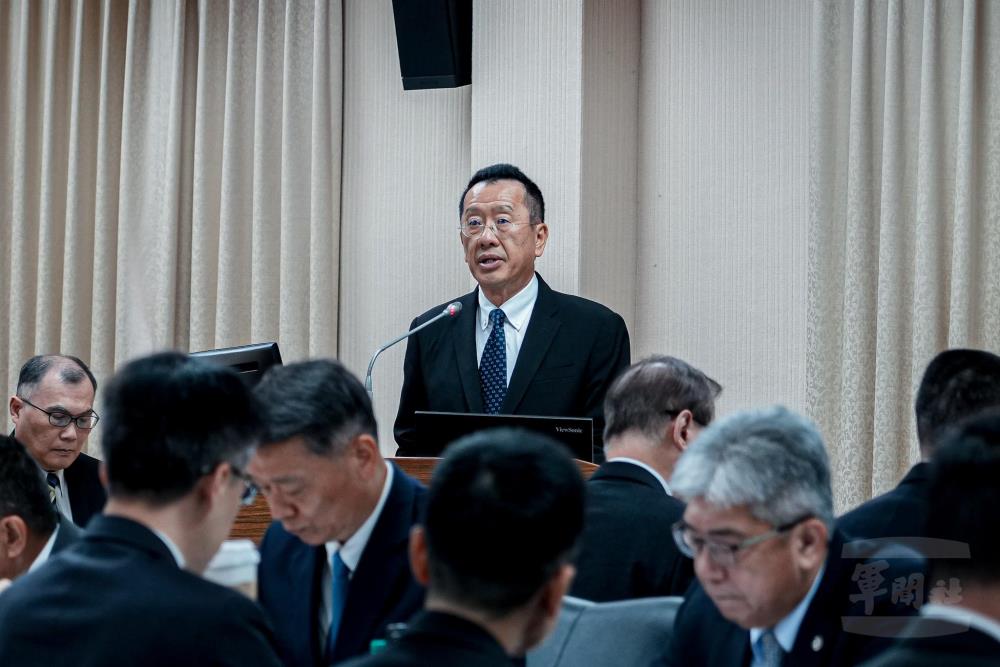
Minister of National Defense Wellington Koo appeared today before the Legislative Yuan’s Foreign Affairs and National Defense Committee to deliver a special report entitled “Measures to Improve Procurement Strategies in Response to Contractual Disputes, Contractor Defaults, and Resulting Delays in the Delivery of Military Equipment” and answer legislators’ questions. Minister Koo said that the Ministry continues to pursue the acquisition of weapons and equipment amid challenges including the rapid evolution of emerging technologies, increasingly complex systems integration, risks to global supply chains, and limited sources of supply. In addition to conducting procurement in accordance with the law, the Ministry continues to refine its procurement strategies and contract management mechanisms to ensure that the national budget is effectively translated into the Armed Forces’ overall defense capabilities.
Lieutenant General Chao Ya-ping, Director of the Ministry’s Defense Procurement Office, said that emerging technologies and intelligent weapon systems have become critical to modern warfare. Military procurement must therefore consider not only operational requirements, but also contract performance management, supply chain security, and performance validation. To reduce the risk of delays in contract performance, the Ministry conducts market research and supply chain analyses from the project planning stage to assess current production capacity and prospective contractors’ ability to perform. It also identifies alternative sources and secondary suppliers. Contractual provisions governing the parties’ rights and obligations, liability for breach, and schedule extensions have also been strengthened. Through standardized and phased acceptance procedures, dedicated project monitoring, and on-site inspections of contractors’ facilities, the Ministry is strengthening contract performance management and risk control, improving procurement efficiency, and ensuring that force development projects proceed on schedule.
Lieutenant General Chao further explained that the primary objective of procurement is to acquire weapons and equipment in accordance with project requirements and planned schedules. Through project planning procedures and comprehensive acquisition plans, the Armed Forces procure equipment once funding has been allocated, using channels including foreign military sales, domestic and overseas commercial procurement, and commissioned development or research. All units plan their procurement requirements according to assessed threats and operational needs. In response to recent challenges such as global supply chain disruptions, fluctuations in raw material prices, interrupted supplies of critical components, and changes in contractors’ production capacity, the Ministry continues to review and improve its procurement system. While maintaining requirements for procurement integrity, national security, cybersecurity, and quality, it seeks to shorten procurement timelines, improve the effectiveness of defense resource utilization, and accelerate the development of overall combat capabilities.
Responding to legislators’ questions about the implementation of a fixed-site counter-unmanned aircraft system project, Minister Koo said that the required proof of concept (POC) had been completed before the tender was issued. During equipment delivery and acceptance testing, however, data from the search radar and passive radar could not be effectively integrated into the system’s operating platform when multiple batches of drone targets were introduced. As a result, the system’s identification capabilities failed to meet the contractual specifications, and the system failed to pass acceptance testing. The Ministry will continue the necessary follow-up procedures in accordance with the contract to ensure that the equipment meets operational requirements.
Army Chief of Staff Lieutenant General Chen Chien-yi further explained that counter-unmanned aircraft systems must combine a range of soft-kill and hard-kill measures in battlefield operations. Their effectiveness is also affected by such factors as the timeliness of database updates, drones’ autonomous flight and anti-jamming capabilities, and the operational environment. Countries around the world are therefore continuing to advance the relevant technologies. To meet the defense requirements of Taiwan’s outlying islands, the Ministry has updated its plans for a next-generation counter-unmanned aircraft system better suited to mission requirements. Procurement can begin once funding has been allocated. Radar detection systems have already been deployed to the outlying islands to maintain defensive capabilities. The special budget for strengthening asymmetric capabilities also includes plans to procure portable systems combining soft-kill and hard-kill countermeasures. The Army will oversee their deployment, with the systems to be progressively allocated to operational units.
Regarding legislators’ questions about the implementation of the limited-quantity procurement mechanism, Minister Koo said that the Ministry has drawn on practices in Europe and the United States and plans to validate equipment performance and operational effectiveness through prototype development, the limited-quantity procurement, and operational testing by military units. However, because the central government’s general budget has not yet completed the statutory review process, some new projects planned for 2026 involving prototype development and the limited-quantity procurement cannot yet proceed. Shih Chi-liang, Deputy Director-General of the Department of Integrated Assessment, said that the military services have completed the relevant test and evaluation plans and could begin testing immediately once funding was allocated, accelerating the fielding of emerging equipment. Minister Koo emphasized that the timely passage of the central government’s general budget would allow force development projects to proceed according to schedule and enhance Taiwan’s overall defense capabilities.