The “Sancha Mountain Incident” occurred just as World War II had ended and peace was beginning to dawn. On September 10, 1945, a U.S. military bomber named Liquidator, carrying released Allied prisoners of war of American, Australian, and Dutch nationalities back to their home countries, crashed on Sancha Mountain—at an elevation exceeding 3,000 meters—at the southern end of the Central Mountain Range under the assault of Typhoon Ursula in the Western Pacific. All 25 persons on board perished.
Upon receiving the news, local communities in Taitung, undeterred by the high mountains, treacherous paths, and severe weather, immediately formed multiple search and rescue teams to rush into the mountains for relief efforts. However, the subsequent Typhoon Jean, bringing fierce winds and torrential rain, ultimately claimed the lives of 26 individuals, including Japanese military police, civilian police, and members of the Amis, Bunun, Pinuyumayan, Siraya, Hoklo, and Hakka communities.
This humanitarian rescue operation—intertwined with typhoons, an air crash, and a mountain disaster, transcending nationality and ethnicity—has since been known as the “Sancha Mountain Incident.” Its brilliance of humanity and sacrifice has never faded.
To honor the souls of the 25 young warriors from distant lands who fought in the war and the 26 brave individuals who perished during the rescue, and to preserve this precious memory, the government formed a task team at the end of June this year. The team trekked through mountains and rivers to return to Sancha Mountain, conducting a four-day, three-night spirit-consolation mission. At the summit, team members held a solemn prayer ceremony, offered flowers and wine, and built a stone cairn to pray for the deceased, paying the highest tribute to the victims with reverent actions, symbolizing the nation and its people’s eternal remembrance of history.
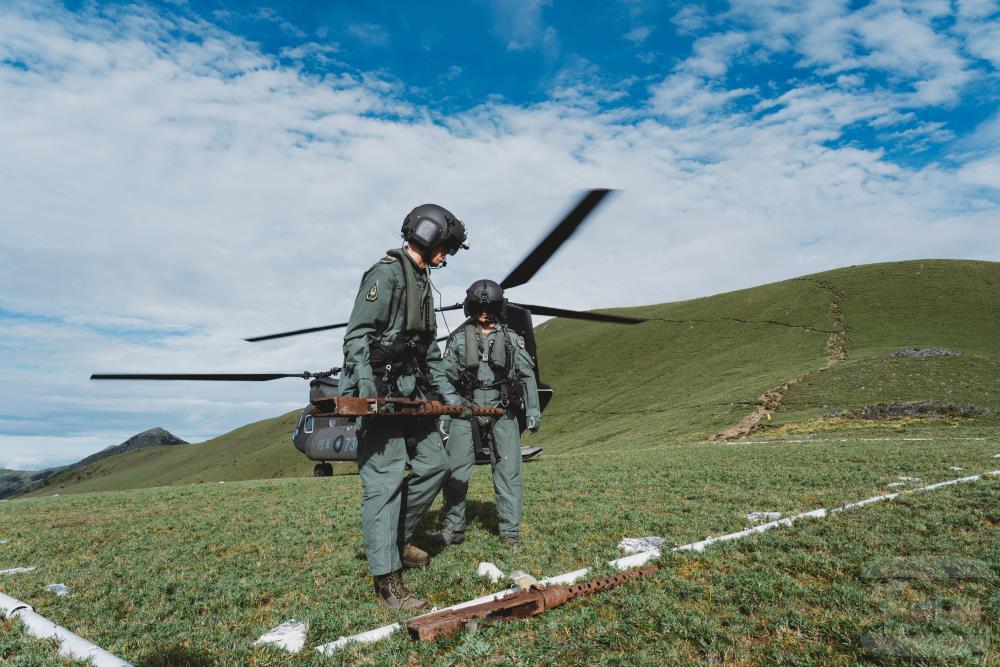
During the mission, the task team ventured into rarely accessed forest zones to survey the crash site, diligently searching for aircraft wreckage and relics from 80 years ago. On September 8, a CH-47 helicopter from Army Aviation landed near Jiaming Lake, retrieving the remains of four machine guns, which were transported back and placed in temporary storage. These will subsequently be systematically catalogued, preserved, and studied by a military museum, with the aim of establishing a complete historical archive and planning an exhibition to ensure this story of humanitarian rescue endures for generations.
The Sancha Mountain Incident highlights the humanitarian spirit of rushing to aid others without regard for borders or ethnic identity under extreme weather and harsh terrain. It is not merely local history but a manifestation of universal human values. As democratic societies worldwide reflect on the historical lesson of World War II—“unity ensures victory, aggression ensures defeat”—Sancha Mountain should not remain merely a site of tragedy but an eternal monument, reminding humanity that only through unity can freedom, democracy, and regional security be safeguarded, laying the foundation for everlasting and genuine peace.