Minister of National Defense Wellington Koo Li-hsiung stated today that, to accelerate the building of asymmetric capabilities and strengthen sustained operational capability, the Ministry of National Defense has consolidated funding for unmanned vehicle procurement for fiscal years 2026 and 2027 in the supplementary budget, with initial operational capability expected in 2027, while strictly implementing non-red supply chain requirements and conducting full teardown inspections to ensure cybersecurity. At the same time, the ministry will build 13 military production lines of its own in phases over several years, procure urgently needed off-the-shelf munitions, and improve pay and benefits for service members. He also clarified that the procurement of the new M109A7 self-propelled howitzers from the United States is proceeding according to milestones. Together, these efforts build up defense capabilities on all fronts.
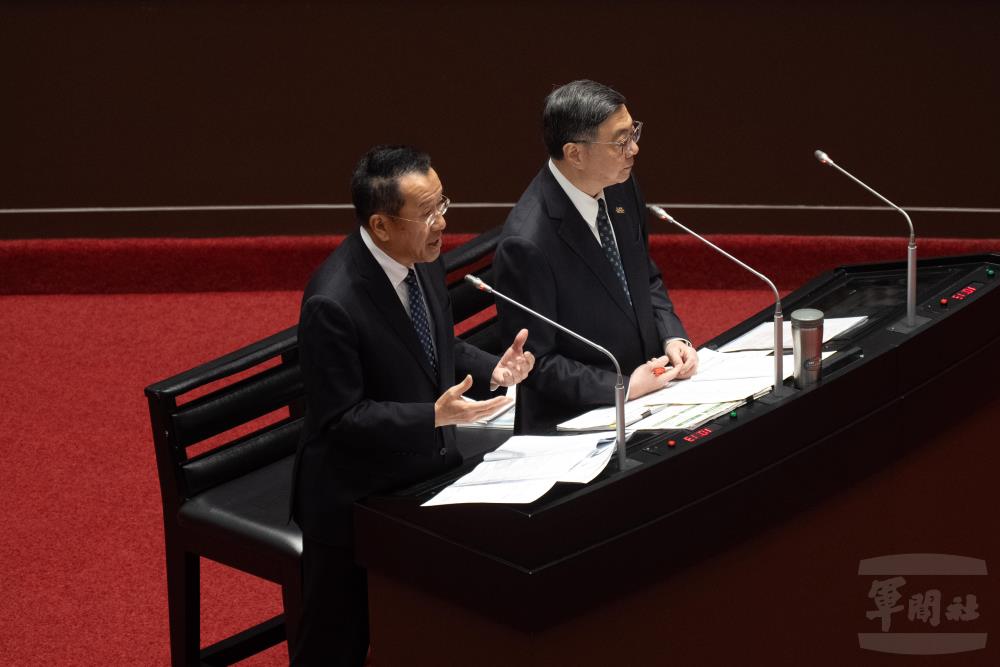
Minister Koo appeared before the Legislative Yuan today to field questions from legislators, one by one, the concerns raised by legislators across party lines regarding the structure of the supplementary budget, the procurement of unmanned vehicles, military production lines, and the progress of arms sales.
Regarding budget allocation and the reasons for combining requirements across years, Minister Koo noted that the original NT$1.25 trillion special budget plan covered arms purchases from the United States, defense self-reliance, and unmanned vehicles. However, when the relevant special act was promulgated on September 11 requiring these items to be incorporated into the annual budget, the general budget for fiscal year 2027 had already been submitted to the Legislative Yuan at the end of August. To prevent the force-building schedule from slipping to 2028, the requirements for 2026 and 2027 were therefore combined into this supplementary budget for execution, and the budgets for the two years need to be viewed together as a whole.
On strengthening combat sustainability, Minister Koo pointed out that the Ministry of National Defense plans to invest approximately NT$14.14 billion from 2026 to 2032 to build 13 military production lines of its own in phases. The urgently needed munitions program totals NT$27.6 billion; this supplementary budget allocates over NT$7.3 billion under operating expenses to purchase 20 types of off-the-shelf munitions from abroad, replenishing munitions stockpiles until the domestically built production lines are completed. As for mobile obstacle equipment, the supplementary budget includes an initial payment of NT$420,000, and the funding required thereafter will be incorporated into the annual budget year by year and submitted to the Legislative Yuan for review and oversight.
Minister Koo explained that, regarding the execution of the NT$55.9 billion unmanned vehicle budget and plans for force buildup, the ROC Armed Forces expect to achieve initial operational capability in 2027, acquiring nearly 700 coastal reconnaissance drones, up to 40,000 coastal strike drones, and 120 one-way attack unmanned surface vessels. Currently, in addition to the Defense Innovation Division conducting small-batch procurement and validation of off-the-shelf products, Class 1 and Class 2 small unmanned aircraft systems (UAS) will be treated as consumables in the same way as "munitions" (with a service life of about 2 years) and procured through "one tender per year, awarded to the most advantageous bid," with additional evaluation points for technological iteration and upgrades. The drones will be consumed through routine exercises and training, with new units acquired year by year, rather than applying the full life-cycle maintenance concept used for traditional main major equipment such as tanks, in order to achieve operational effectiveness.
Minister Koo further explained that, in terms of training and the interagency division of labor, each service branch has established a drone training command. Before the systems are delivered, trainer drones are used for basic operator and instructor training; after delivery, contractors assist with training and units carry out expanded training. In addition, the unmanned vehicles of the ROC Armed Forces are intended to build "mobile, intelligent, and autonomous strike capabilities," working with anti-ship missiles to conduct layered littoral strikes and counter PLA landings. This differs from the Coast Guard Administration's use of drones for nearshore law enforcement; the two sides have signed a resource-sharing agreement and will support each other through intelligence exchanges.
Minister Koo emphasized that, regarding the "non-red supply chain" for key drone components and cybersecurity protection mechanisms, the Ministry of National Defense has established a registry of key component manufacturers and a multi-layered inspection process. In addition to requiring documentation certifying the original manufacturer and country of origin and the signing of affidavits, the ministry also conducts on-site factory inspections in advance to verify production line layouts and the physical isolation of software, and performs full teardown inspections and rigorous software cybersecurity testing during prototype test flights and upon delivery. If flight control and communication modules require technical cooperation with foreign partners, cybersecurity requirements and supply chain source verification will likewise be strictly enforced to eliminate the risk of infiltration by hostile forces.
Furthermore, in response to media reports that the United States had asked Taiwan to change the M109A7 self-propelled howitzer arms sale to a purchase of the older M109A6 upgraded and remanufactured version, Minister Koo firmly clarified that the reports were inconsistent with the facts and that the United States had made no such request. Taiwan has signed Letter of Offer and Acceptance (LOA) and is proceeding according to milestones, and the Ministry of National Defense is resolutely committed to procuring the new M109A7 self-propelled howitzers based on combat readiness needs. As for the progress of Taiwan–U.S. joint research and development projects, because classified information is involved, a report will be made to the committee in a classified briefing. Regarding the NT$4.1 billion allocated in the supplementary budget to improve military pay and benefits, NT$2.5 billion will go toward an increase in volunteer military personnel, allowances, and insurance, while the other NT$1.6 billion will fund a new Type III Combat Unit Allowance and extend eligibility for the combat unit allowance to conscripts, thereby safeguarding the rights and interests of service members.