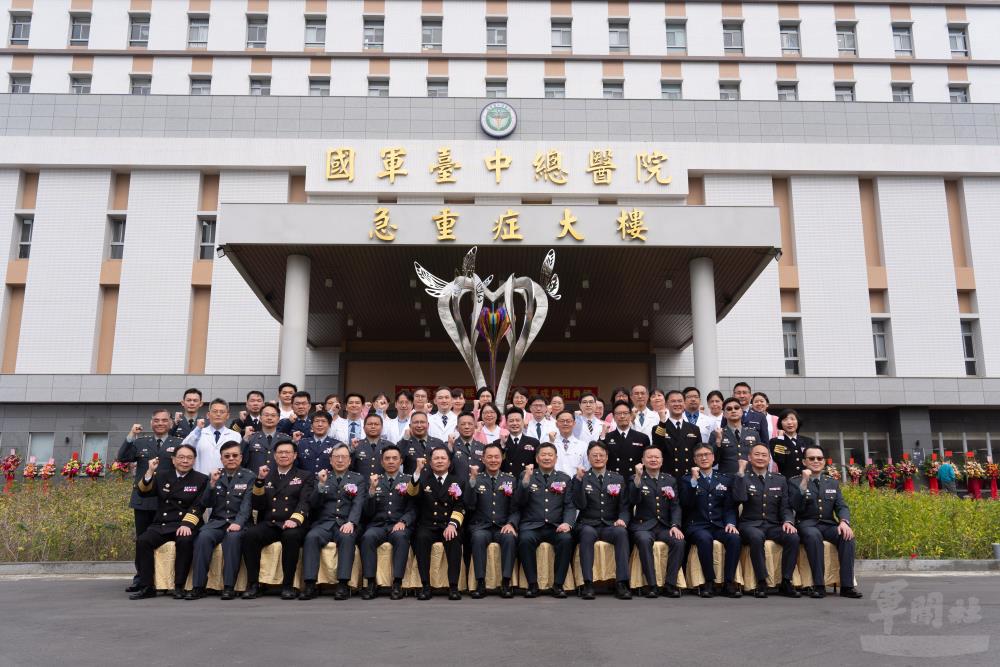
On presiding over the inauguration ceremony of the “New Medical Building” at the Taichung Armed Forces General Hospital today, Vice Minister of National Defense General Chung Shu-ming emphasized that the completion of this building symbolized an overall upgrade in medical services in Taiping area, enabling local residents and service members to enjoy the highest quality and most comprehensive medical care at the Taichung Armed Forces General Hospital.
Vice Minister Chung, accompanied by Navy Administrative Deputy Minister of Vice Admiral Huang Yu-min, Medical Affairs Bureau Director-General Lieutenant General Tsai Chien-sung, presided over the building inauguration ceremony this morning. After receiving a briefing, Vice Minister Chung offered guidance on enhancing medical capacity.
Vice Minister Chung pointed out that “holistic patient care” as its core principle, the new Medical Building fully incorporated smart green building to optimize medical workflows and operational spaces. The hospital featured modular operating rooms and intelligent nursing stations equipped with digital electronic whiteboards, smart bedside cards, and bedside service systems, creating a safe and efficient medical environment. Since 2016, the Ministry of National Defense has promoted the “Soaring Medicine Project,” and the results are now evident. The completion of this new building represents an important milestone in the military medical system’s modernization and smart healthcare transformation.
During the inspection of the new building, Vice Minister Chung interacted cordially with military medical personnel and specially encouraged them with the mottos “history, responsibility, mission,” urging them to inherit the excellent tradition, shoulder the responsibility of caring for comrades, and take safeguarding public health as their highest mission.
Vice Minister Chung reminded military medical cadres, “Military medical personnel should treat patients as family,” whenever service members suffer major injuries or illnesses, the entire military feels deep sorrow, and therefore he expects the military medical system to play a pivotal role in providing the most timely and professional medical assistance.
In addition, during his remarks at the ceremony, Vice Minister Chung praised Lieutenant General Tsai Chien-sung, Director-General of the Medical Affairs Bureau, who was to retire with honor on February 1. Vice Minister Chung referred to Director-General Tsai as his “good classmate” and stated that during his more than three years as Director-General, he led sustained improvements in the military medical system, achieving a balance between “field military medicine in combat theater command” and “civilian medical care” in both peacetime and wartime, making indispensable contributions to military medicine. Vice Minister Chung invited all attending guests to give Director-General Tsai a warm round of applause on the spot, publicly commending his noble spirit of dedication to medical practice.
Vice Minister Chung retraced Director-General Tsai’s tenure, during which he not only promoted the transformation of the National Defense Medical Center into National Defense Medical University, established forward surgical teams, and deepened exchanges with the U.S. Indo-Pacific Command for talent cultivation, but also, with a spirit of “selflessness and dedication,” let the world see Taiwan’s medical technology. He encouraged all personnel to inherit this spirit and jointly build resilient, high-quality medical capabilities.