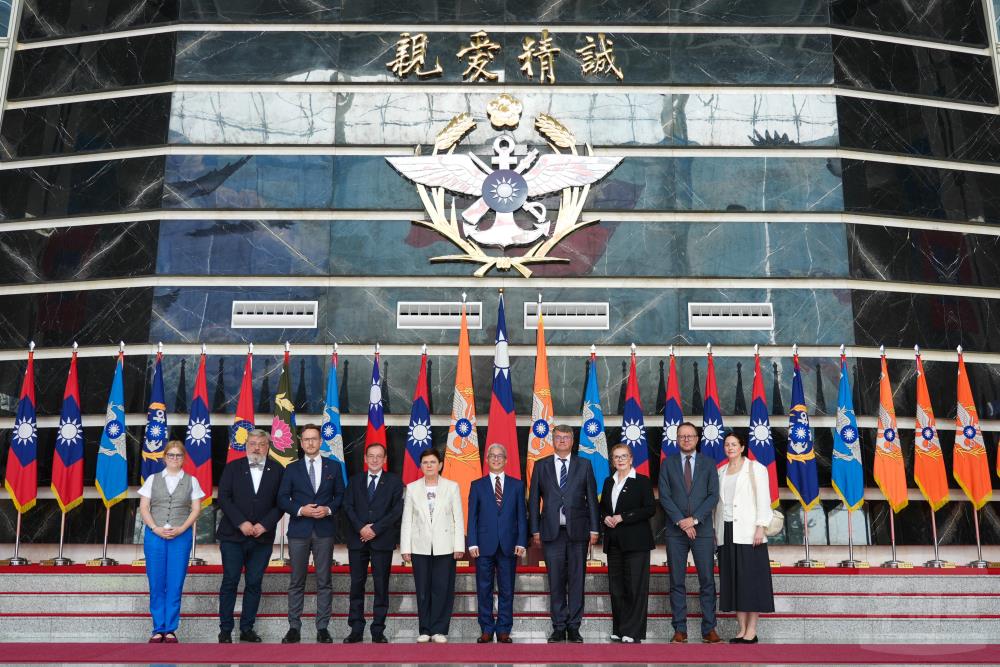
Vice Minister of National Defense Hsu Szu-chien today received a delegation led by Beata Szydło, a member of the European Parliament’s Special Committee on the European Democracy Shield and former Prime Minister of Poland. The two sides exchanged views on the security situation in the Indo-Pacific, China’s gray-zone harassment, and whole-of-society defense resilience. They also held in-depth discussions on how democracies can jointly respond to authoritarian expansion and deepen security cooperation, demonstrating Taiwan and Europe’s shared commitment to maintaining regional peace and stability.
The delegation arrived at the Ministry of National Defense’s Bo’ai Camp this morning, where Vice Minister Hsu welcomed the guests on behalf of the Minister of National Defense, Wellington Koo. In his remarks, Hsu said that China has increasingly employed a combination of military pressure, cognitive warfare, and gray-zone harassment in recent years, posing challenges to security across the Taiwan Strait and throughout the Indo-Pacific. In response, the government is not only continuing to strengthen Taiwan’s defense capabilities, but also actively enhancing digital resilience and cybersecurity to address the risks posed by China-linked supply chains. It is also advancing the development and application of unmanned systems to strengthen overall defense capabilities, preserve Taiwan’s democratic and free way of life, and maintain regional peace and stability.
Whole-of-society defense resilience is a vital foundation of national security, Hsu said. Through cooperation between central and local governments, civil society participation, and cross-sector integration, the government is building a more comprehensive national defense framework. Exercises such as the Urban Resilience Exercise are also used to test interagency coordination and civil-military integration. This year’s Urban Resilience Exercise included a network throttling drill for the first time. The drill tested the ability of government agencies and the private sector to respond to compound threats and provided an opportunity to further refine Taiwan’s digital resilience and critical infrastructure protection mechanisms.
Vice Minister Hsu thanked the European Parliament for its longstanding attention to security across the Taiwan Strait and its support for Taiwan’s participation in the international community. He said Taiwan would continue deepening exchanges and cooperation with like-minded countries. By sharing experience and expanding cooperation in security, cybersecurity, and whole-of-society defense resilience, Taiwan and its partners can jointly uphold the rules-based international order and safeguard peace, stability, and prosperity in the Indo-Pacific.