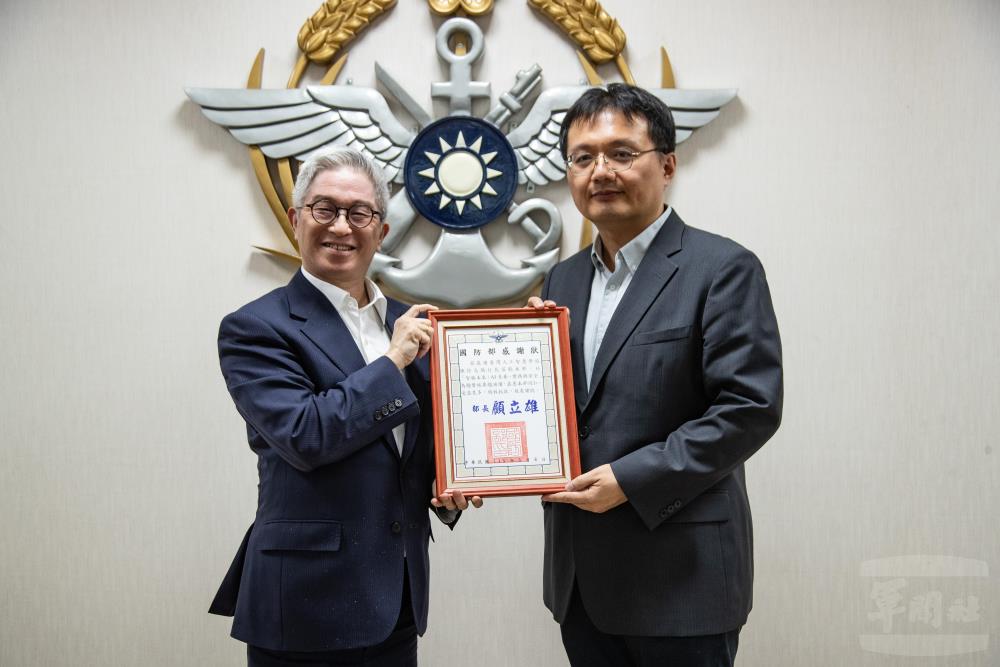
The Ministry of National Defense held the “Artificial Intelligence Governance Committee Special Lecture and ROC Armed Forces AI Development Concept Seminar” yesterday (April 8) at the Bo’ai Camp. Vice Minister for Policy Hsu Szu-chien presided over the event and invited National Security Council Advisor Li Yu-chieh to provide guidance. Participants included members of the Ministry’s Artificial Intelligence Governance Committee (unit heads), commands of the three services, the National Defense University, and the National Chung-Shan Institute of Science and Technology. The goal was to draw on practical experience from industry and academia to enhance the AI literacy of the ROC Armed Forces and lay a foundation for promoting AI development in national defense.
In his remarks, Vice Minister Hsu stated that lectures only provided inspiration, while implementation was the key. He encouraged commanders at all levels to shift from passive to active approaches and actively apply diverse AI technologies. The Ministry of National Defense fully supported each unit in advancing their projects, hoping that through AI technology, administrative operational efficiency could be effectively improved and new momentum could be injected into the modernization of the ROC Armed Forces.
The special lecture invited Dr. Chen Ling-Jyh, Director of the Department of Information Technology Services, Academia Sinica and Chief Executive Officer of the Taiwan AI Academy, to speak on the topic “Winning the Future: AI Literacy, Practice, and Security.” He explained the evolution of AI development from “perception” to “physical embodiment” and shared Academia Sinica’s practical experience, including how they built a “Large Language Model (LLM)” under strict cybersecurity controls, and how they developed speech recognition transcription systems, question-and-answer robots, and document verification tools to effectively resolve pain points in public administration and simplify operational processes.
Regarding military applications, Dr. Chen specifically proposed the “Nine Reminders for Promoting Defense AI,” which covered core concepts such as infrastructure resilience and human-machine collaboration. He also explained the risks and challenges of introducing AI, reminding all units to establish mechanisms for verifying the authenticity of information and to strictly prevent the leakage of sensitive data. At the same time, he emphasized that introducing AI technology was an urgent and important task. Only by accelerating the implementation and application of the technology could the digital transformation of the ROC Armed Forces be effectively strengthened.
The Ministry of National Defense stated that the AI Project Office’s organization of this special lecture and comprehensive seminar helped integrate common needs across units and initiated the process of advancing the ROC Armed Forces toward digital development.