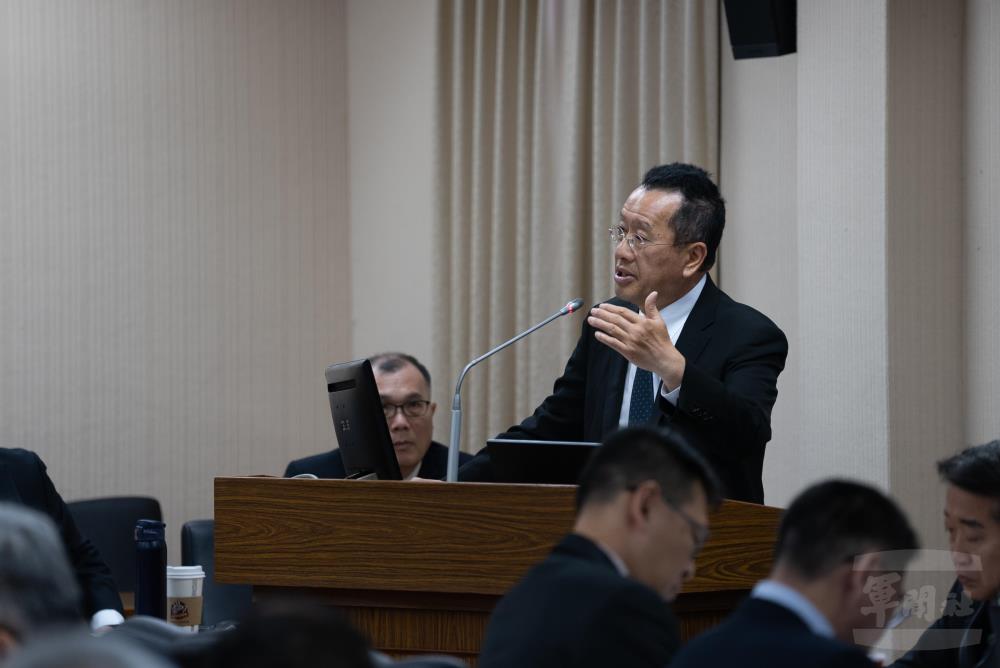
Minister of National Defense Wellington Koo Li-hsiung appeared before the Legislative Yuan’s Foreign Affairs and National Defense Committee today to deliver a special report on how the Armed Forces are strengthening service members’ morale and psychological resilience in response to escalating enemy threats and gray-zone activities.
Minister Koo began by noting that China continues to employ gray-zone harassment, cognitive warfare, disinformation, recruitment, and infiltration in an attempt to influence service members’ perceptions and undermine unit cohesion. Morale and psychological resilience have therefore become indispensable foundations of force development and combat readiness. Guided by the principle of “reflecting the threat environment and supporting preparation for war,” the Ministry will continue strengthening service members’ will to resist the enemy, awareness of enemy threats, and unit morale to ensure combat effectiveness.
Political Warfare Bureau Director-General Lieutenant General Shih Shun-wen further explained that the Armed Forces currently build morale and psychological resilience through four principal areas: unit education, recruit education, reserve refresher training, and military school education. At the unit level, Chu-Kuang Day instruction, security and counterintelligence briefings, calculated risk-taking and battlefield stress-resilience courses, and mental health education are used to strengthen service members’ will to fight and reinforce their psychological defenses.
For recruit education, a General National Defense Education Course has been added to initial military training. In 2024, the Ministry published the Beginning Your Military Service teaching materials, covering Armed Forces history, military ethics, Chinese cognitive warfare, human rights in the military, information security, and counterintelligence. Recruits receive 16 hours of instruction during initial training. A multimedia database has also been established on the General National Defense Education website for use by recruit training units.
To help reservists understand current defense policies and enemy threats while strengthening their morale and patriotic commitment, the Ministry published the Mobilized and Combat-Ready teaching materials in 2024. Reservists receive five hours of instruction during refresher training, supported by educational videos from a multimedia database to improve the quality of the program. Military school education includes five political education courses totaling 12 creditswithin the common general curriculum. Subjects include the Constitution and Founding Principles of the Republic of China, the History and Development of the Republic of China, and Studies on Mainland China. These courses are intended to develop military officers’ understanding of democracy and constitutional government, strengthen cadets’ awareness of enemy threats and military ethics, and cultivate their ability to understand both themselves and their adversaries.
Lieutenant General Shih emphasized that morale education and psychological resilience have become important strategic foundations for building sustained combat capabilities and whole-of-society defense resilience. The Ministry will continue refining its educational methods and content by strengthening Chu-Kuang Day instruction, General National Defense Education, security and counterintelligence education, battlefield stress training, and psychological resilience training. These efforts will be integrated into routine education, combat-readiness preparation, exercise and training evaluation, and threat awareness education to foster among service members a clear understanding of friend and foe, a strong sense of national identity, and a shared will to defend the country.