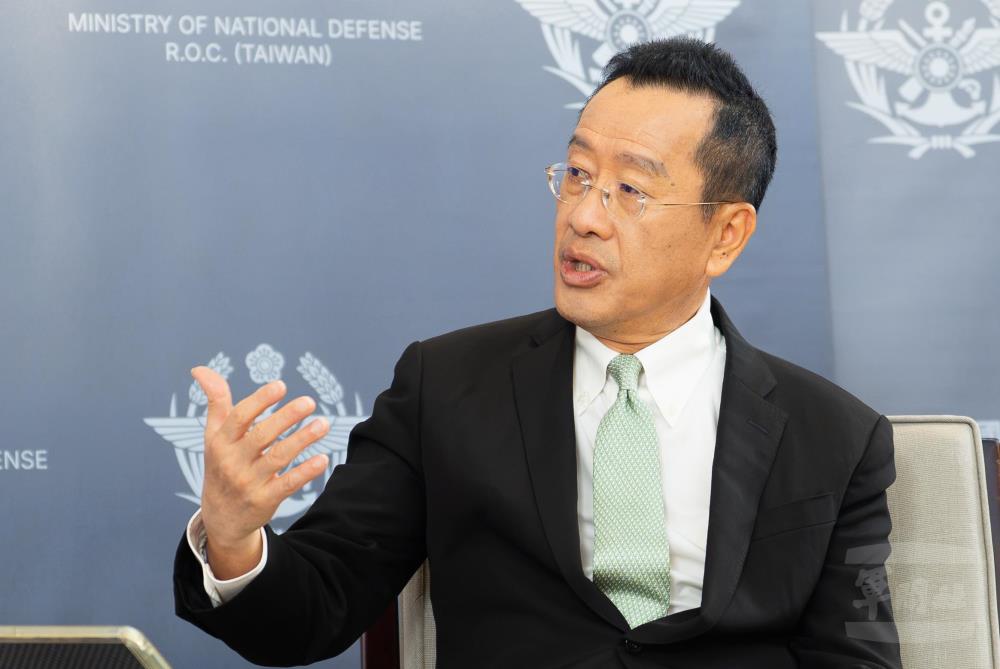
With the field-training phase of the “Han Kuang 42 Live Exercise” set to begin soon, Minister of National Defense Wellington Koo Li-hsiung said in a recent media interview that this year’s exercise will have higher-echelon units play the role of the “opposing force” and continuously inject unscripted scenarios based on the latest patterns of threats posed by China. The approach is intended to strengthen commanders’ ability at all levels to respond to changing circumstances and exercise decentralized command and control. The Armed Forces have also shifted away from the previous concept of seeking “a decisive battle at the shoreline” toward “multi-domain denial,” while adjustments to the force structure and more precise mobilization are being used to build sustained operational capability.
Minister Koo recently sat down for interviews with the Central News Agency and other media outlets, accompanied by Vice Chief of the General Staff (Executive) General Huang Chih-wei, Director-General of the Department of Strategic Planning Lieutenant General Huang Wen-chi, and Deputy Chief of the General Staff for Operations and Planning Lieutenant General Hou Chia-lun. During the interviews, he responded to questions on realistic training in the Han Kuang Exercise, operational resilience, force structure, and precision mobilization.
Addressing efforts to make this year’s Han Kuang Exercise more realistic, Minister Koo said, “Training can always be improved.” Higher-echelon units will serve as the “opposing force,” injecting unscripted scenarios in real time in response to developments during the exercise. This will train commanders at every level to understand their higher headquarters’ intent as well as their own missions. Even in a worst-case scenario in which command centers are destroyed or contact with higher command is lost, units down to the company, platoon, and squad levels must still be able to continue carrying out their combat missions.
Vice Chief of the General Staff (Executive) General Huang Chih-wei noted that corresponding conflict scenarios will be incorporated into every phase of the exercise, including scenarios involving lawfare, cognitive warfare, and gray-zone activities based on the latest patterns of threats posed by China. Minister Koo further explained that these scenarios are not devised in isolation, but are based on assessments of the threat environment and joint operations plans. Units at all levels will continually be presented with changing situations requiring them to adapt, ensuring that every service member clearly understands the mission and can put decentralized command and control into practice.
Deputy Chief of the General Staff for Operations and Planning Lieutenant General Hou Chia-lun said the Armed Forces have transformed their approach to realistic training. Instead of moving according to a predetermined schedule to designated locations to carry out preplanned tasks, training now incorporates existing key military positions and facilities as well as current battlefield conditions, with unscripted scenarios continually expanding the scope of the exercise. At the same time, the Armed Forces have shifted their strategic thinking from seeking a “decisive battle at the shoreline” toward “multi-domain denial.” Defense operations plans are being revised accordingly to incorporate the concept of overall defense resilience.
Responding to public interest in the Armed Forces’ ability to sustain operational capability, Minister Koo stressed that Taiwan does not plan on the assumption that its forces must fight for a prescribed number of days. The fundamental objective is to ensure that any full-scale Chinese invasion fails. Exercise training will extend from the preservation of frontline combat power to operations in depth, progressively testing sustained combat operations through different phases. Preparations also encompass logistical resupply, personnel replacements, combat-power regeneration, and cross-regional maneuver, all integrated with whole-of-society defense resilience.
On force structure, Minister Koo said recruitment targets for the volunteer force have been met and overall personnel numbers are trending upward. The Armed Forces will continue to build up overall manpower through the dual-track system of volunteer and compulsory military service. Next year, the first cohort subject to one-year compulsory military service will graduate from university, with approximately 30,000 conscripts expected to enter service. They will undergo a complete training progression covering basic training, home-station training, base training, and joint operations training before gradually reinforcing frontline combat units, garrison brigades, and reserve forces. After completing their service, reservists are expected to be called up for 14 days of refresher training annually, replacing the previous schedule of 14 days once every two years. This will enable them to rapidly regain combat proficiency upon mobilization and implement the principle of “returning personnel to their original wartime assignments.”
Minister Koo added that the Armed Forces will review combat-readiness indicators brigade by brigade and battalion by battalion, including personnel levels, equipment readiness, training, and logistics. This will enable more precise assessments of each unit’s organization, specialist skills, and requirements for replacing personnel and materiel lost through combat or attrition. Civil-military integration and mechanisms for mobilizing manpower and material resources will also be incorporated to improve the precision of reserve management and mobilization. Former service members who acquire highly specialized skills in the civilian sector after leaving the military will also be incorporated into the mobilization management system and, when necessary, may be specifically selected for assignments based on their expertise. The resumption of selection programs for reserve officers and noncommissioned officers will help replenish junior leadership positions in garrison and reserve units. For highly specialized Navy and Air Force positions involving aviation, ships, logistics, and other technical fields, the All-out Defense Mobilization Agency will consolidate the requirements of the three services and maintain an accurate picture of veterans possessing the necessary expertise.
Lieutenant General Huang Wen-chi, Director-General of the Department of Strategic Planning, said this year’s Han Kuang Exercise will also incorporate large-scale medical resilience preparations and the mobilization and integration of defense industries to validate sustained combat and mobilization readiness. These activities will test the integration of medical, logistical, and industrial capacity with the Armed Forces’ ability to sustain operations, further strengthening their capacity to respond to a complex battlefield environment and enhancing overall defense resilience.