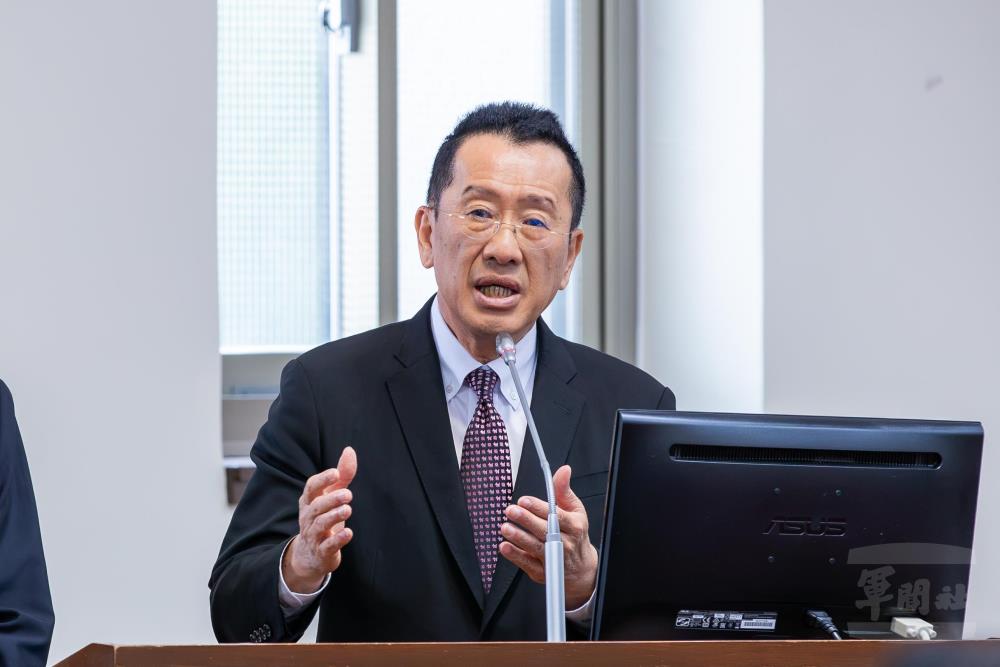
The Legislative Yuan’s Economics, Foreign Affairs and National Defense, and Finance Committees today held the second joint meeting of the fifth session of the 11th Legislative Yuan to review draft versions of the Special Act for the Procurement of Domestically Developed Unmanned Vehicles for National Defense proposed by the Executive Yuan and various legislative caucuses. With the exception of Proposal No. 13, which will undergo further review at a later date, the proposals were referred for cross-party negotiations before being submitted to the legislative plenary for deliberation. Minister of National Defense Wellington Koo Li-hsiung said that a special act must have a clearly defined purpose and specific procurement targets. The Executive Yuan’s version focuses on coastal reconnaissance drones, coastal attack drones, and small one-way attack unmanned surface vessels. These systems would be acquired through a special budget to meet operational requirements for the defense of the Taiwan Strait and strengthen overall defense resilience.
Minister Koo explained that unmanned systems encompass a wide range of aerial, ground, surface, and underwater platforms. Including within a single act the specific systems currently planned for procurement, other platforms that may be developed in the future, indigenous production, and overseas procurement would leave the procurement targets insufficiently defined. Defense procurement should be conducted by the Ministry of National Defense based on its professional assessments and operational requirements, while the Ministry of Economic Affairs should guide industrial development. Although the two functions do not conflict, they should not be conflated. Deputy Minister of Economic Affairs Ho Chin-tsang agreed that his Ministry could not decide which platforms the Ministry of National Defense should procure. Designating the Ministry of National Defense as the competent authority would provide a clearer division of responsibilities.
Regarding procurement methods, Minister Koo explained that the Executive Yuan’s bill primarily covers the acquisition of Category I and Category II drones. The Ministry has completed assessments of domestic production capacity and market conditions. Subsequent procurement will use open tendering with multiple awards, allowing qualified domestic manufacturers to participate. If the National Chung-Shan Institute of Science and Technology has systems that meet the Ministry’s operational requirements, they will be acquired separately through commissioned production. Procurement programs will also require contractors to continually improve the performance of flight-control software, communications modules, and other components. Long-term orders will help drive iterative innovation throughout Taiwan’s domestic industry.
Regarding funding, Deputy Minister Ho said the Executive Yuan’s version sets a ceiling of NT$210 billion and provides funding through a special budget. As the budget would not be subject to the restrictions under Article 23 of the Budget Act, it could provide a stable, long-term source of funding. This approach would reduce procurement uncertainty arising from competition with other budgetary requirements, funding cuts, or delays in the review process, thereby increasing manufacturers’ willingness to invest. Minister Koo cautioned that bringing all unmanned systems under the legislation and requiring the central government to allocate a fixed amount in its annual budget could create discrepancies between actual requirements and the statutory funding level. It could also raise questions about how the Legislative Yuan would subsequently review the funding.
The Executive Yuan’s version specifies three types of unmanned systems, but this does not mean that they represent the Ministry’s only requirements, Minister Koo emphasized. Other large and medium-to-large drones, unmanned ground vehicles, and unmanned underwater vehicles that may be procured once the necessary technologies mature will still undergo project planning based on operational requirements. Funding will then be included separately in annual budgets or other procurement programs. Citing the delivery of MQ-9B unmanned aircraft as an example, Minister Koo said the relevant funding is provided through the annual budget. Different types of unmanned systems serving different purposes should therefore be funded through mechanisms appropriate to their specific operational requirements.
Addressing domestic-content requirements proposed in some versions of the bill, Deputy Minister Ho said that unmanned systems vary considerably. The feasibility of domestic production for each platform is also affected by uncertainties such as the pace of technological development and changes in market conditions. Writing a uniform domestic-content percentage into law could therefore create difficulties during implementation and subsequent procurement. Minister Koo added that military unmanned systems procured from overseas could not readily comply with a fixed domestic-content requirement. The Ministry’s procurement of unmanned systems must remain based on military specifications that meet operational requirements. Existing industry support mechanisms and related programs already cover research and development subsidies, investment tax credits, talent development, testing and certification, and supply chain integration.
Some legislative proposals also addressed testing sites, production bases, readiness stockpiles, and deployment arrangements. Minister Koo explained that testing sites involve the respective responsibilities of the Ministry of National Defense, Ministry of Transportation and Communications, and local governments and should therefore be coordinated at the Executive Yuan level. Military exercise areas or restricted military zones should not be directly designated by law as testing sites. Similarly, the quantities of unmanned systems held in readiness and their deployment locations should be determined by the Ministry of National Defense according to operational requirements and professional planning. Publicly stipulating such information in legislation could create national security concerns. The Ministry hopes that the Legislative Yuan will support the Executive Yuan’s version, which clearly defines the procurement targets, competent authorities, and source of funding, allowing resources to be concentrated on acquiring priority equipment.