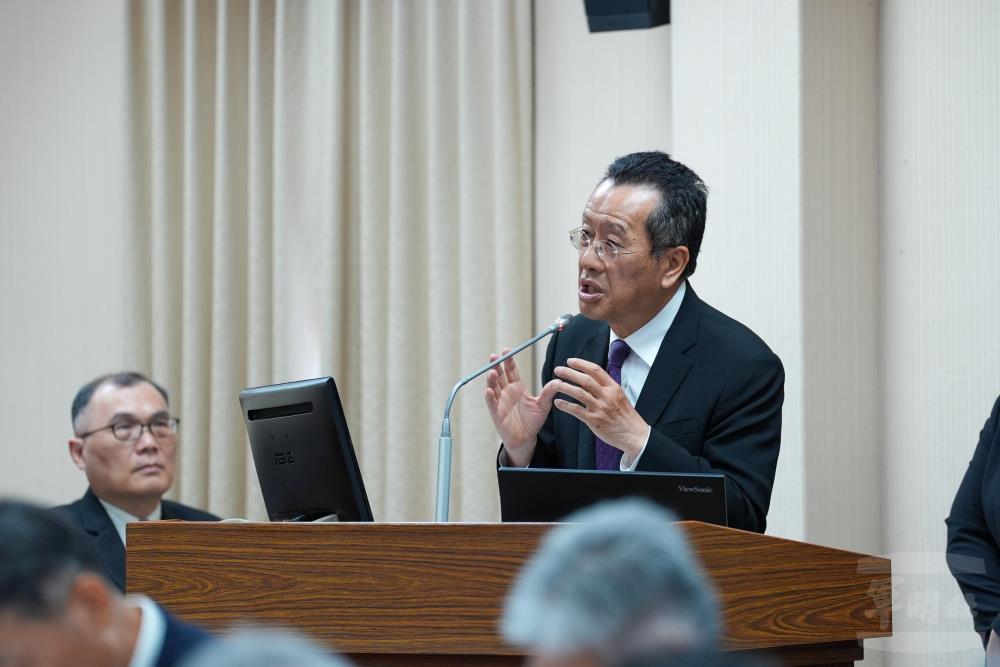
Minister of National Defense Wellington Koo Li-Hsiung appeared today before the Legislative Yuan’s Foreign Affairs and National Defense Committee to deliver a special report entitled “Armed Forces Human Resources Policies and Future Response Plans amid the Impact of the Declining Birth Rate” and answer legislators’ questions. Responding to legislators’ concerns about cross-unit support duties and personnel utilization within the Armed Forces, Minister Koo said that a two-phase pilot program to outsource security duties at military schools would be introduced to ease the burden on frontline units. This would allow personnel currently assigned to support duties to return to their parent units and focus on their primary combat training responsibilities.
Minister Koo stated that optimizing and making effective use of defense personnel is critically important in the face of Taiwan’s declining birth rate. To reduce the number of non-combat duties assigned to military units, the Ministry of National Defense plans to begin by piloting the employment of private security personnel at military schools. The first phase will officially begin on September 1 this year and cover five campuses: three National Defense University campuses, the Republic of China Military Academy, and the Republic of China Naval Academy. The second phase is scheduled to begin on January 1 next year and will expand the program to four additional locations, including the Army Academy R.O.C., Air Force Institute of Technology, and Chung Cheng Armed Forces Preparatory School. Once completed, security duties will have been outsourced at a total of nine military school campuses.
Minister Koo emphasized that employing private security personnel would eliminate the need for military personnel to perform sentry duties and related support assignments on these campuses. This would not only reduce the routine workload of frontline service members but also allow personnel currently assigned to support duties to return to their parent units and devote their full attention to combat readiness and military training. By fulfilling the central objective of enabling service members to focus on their primary combat training responsibilities, the initiative will further ensure that the Armed Forces’ overall defense capabilities are not undermined by the declining birth rate.