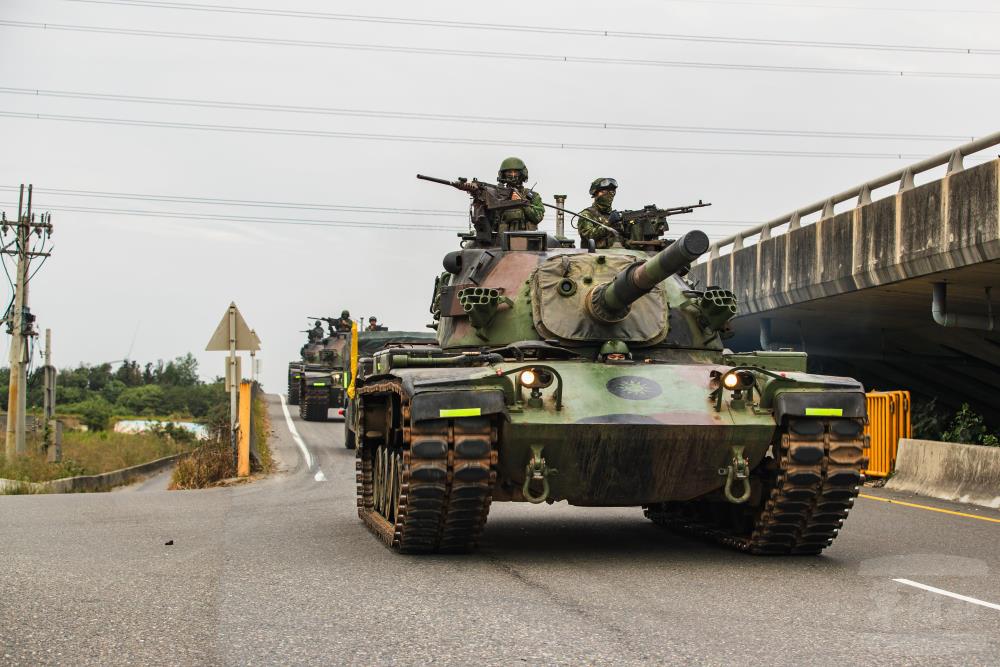
The ROC Armed Forces recently conducted the seven-day, six-night “Land Victory No. 1 Exercise” in the central region, which concluded successfully on October 31. The Army Education, Training and Doctrine Development Command served as the exercise control headquarters, integrating the 542nd Armored Brigade of the Sixth Army Corps and the 234th Mechanized Infantry Brigade of the Tenth Army Corps. The exercise was executed using real troops, real locations, and real equipment in offensive-defensive confrontation, with cross-regional maneuver exceeding 200 kilometers, validating brigade-level joint combat and command-and-control effectiveness.
The exercise was based on defensive operations scenarios and adhered to the three major principles of “real troops and real equipment, free-play control, and phased management.” Through scenario induction, participating units were guided to complete subjects including attack, defense, meeting engagement, pursuit, and successive resistance, testing commanders at all levels in on-the-spot judgment and communications maintenance capabilities. The exercise integrated drones and the Team Awareness Kit (TAK), utilizing real-time imagery and surveillance information return to enhance battlefield awareness and command efficiency, achieving the objectives of “precise enemy situation awareness, rapid decision-making, and flexible troop employment.”
This was the first time the Army Education, Training and Doctrine Development Command served as exercise control headquarters, responsible for planning, execution, and evaluation tasks from an objective and impartial standpoint, with exercise outcomes fed back into education, training, and doctrine revision. The drill incorporated real-world terrain and communications interference testing to hone units’ adaptability in complex situations. Personnel at all levels embodied the spirit of “training with the enemy in mind,” completing missions were accomplished under unscripted induction, strengthening defensive combat thinking.
Due to the long-duration and long-distance nighttime maneuvers, the exercise posed significant mental and physical challenges to the personnel. Prior to the exercise, units conducted long-distance nighttime driving, equipment inspections, and on-site reconnaissance to familiarize personnel with terrain characteristics and civilian facility locations, facilitating subsequent tactical employment.
During the exercise, civilian facilities supported field locations, and local residents enthusiastically assisted units with quartering and rest. They expressed that having the military train locally “brings the armed forces closer to the people.” Residents also stated that seeing tanks and service members operating in the community gave them a sense of the responsibility to defend the homeland and deepened public understanding of the hardships faced by military personnel.
Following the conclusion of the exercise, the exercise control headquarters completed full-process evaluation and tactical review, compiling communications and operational data as a basis for future training improvements. The Army Education, Training and Doctrine Development Command stated that it will continue to refine education, training, and operational research based on these results to enhance overall unit combat effectiveness.