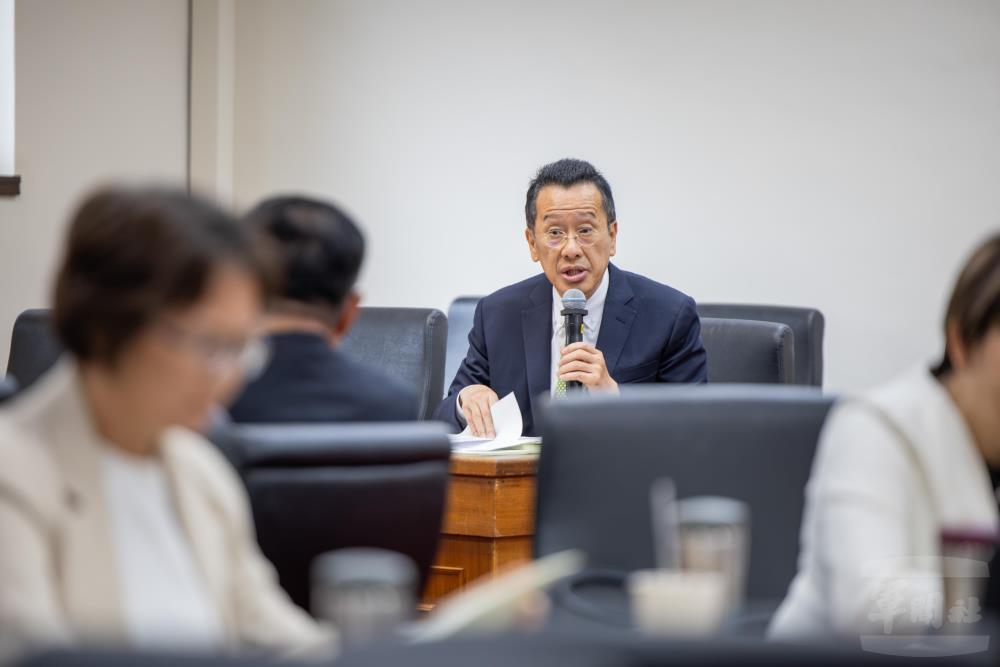
Minister of National Defense Wellington Koo Li-hsiung attended cross-party caucus negotiations today on the draft “Special Act for Unmanned Systems.” He said unmanned capabilities are a critical component of the Armed Forces’ force development and combat readiness and expressed hope that opposition parties would carefully reconsider the proposed annual budget ceiling of NT$40 billion so that Taiwan’s overall defense resilience can be strengthened.
The Legislative Yuan’s Economics, Foreign Affairs and National Defense, and Finance Committees conducted caucus negotiations today on 14 proposals, including the “draft Act for the Development and Procurement of Indigenous Defense Unmanned Vehicle Technologies.” As the ruling and opposition parties failed to reach agreement on the legislation’s title, competent authority, and sources of funding, all 14 proposals reserved and referred to the plenary for further cross-party negotiations.
Minister Koo said the KMT’s version defines unmanned vehicles as systems operated by remote control, autonomous control, or other means in the air, on the water’s surface, underwater, on the ground, or in other environments. Their missions include surveillance and reconnaissance, target acquisition, strikes, logistics transport, communications relay, electronic warfare, decoy operations, mine clearance and laying, and other tasks. Article 16 of the proposal would allocate NT$40 billion annually through the regular budget process for six consecutive years, for a total of NT$240 billion.
Minister Koo noted that the 2027 budget already allocates NT$31 billion for unmanned capabilities through military procurement, contracted production, and commercial procurement. This figure does not include the coastal-surveillance, coastal-strike, and one-way attack unmanned surface vessels proposed under the special act. If the special act passes, an additional NT$13.8 billion would be allocated in 2026 and NT$42.1 billion in 2027, for a combined total of NT$55.9 billion, exceeding the proposed NT$40 billion ceiling.
Minister Koo emphasized that the KMT version would place all remotely operated unmanned systems used for surveillance and reconnaissance, target acquisition, strikes, logistics transportation, communications relay, electronic warfare, mine clearance and laying, and other missions, including aerial and ground systems, under the same NT$40 billion ceiling. Such a restriction would prevent the Ministry from developing an effective force structure for unmanned capabilities. He earnestly urged the KMT caucus to reconsider the Armed Forces’ critical need for these capabilities so that budgetary constraints would not prevent their effective employment.
Regarding the proposed six-year funding period, Minister Koo added that the Ministry would procure systems annually rather than purchase six years’ worth of surveillance and reconnaissance, strike drones, and small unmanned attack platforms in a single acquisition. Through the relevant committee mechanisms, the Ministry would also require each year’s specifications to improve upon those of the preceding year to maintain the pace of iterative innovation in unmanned systems.