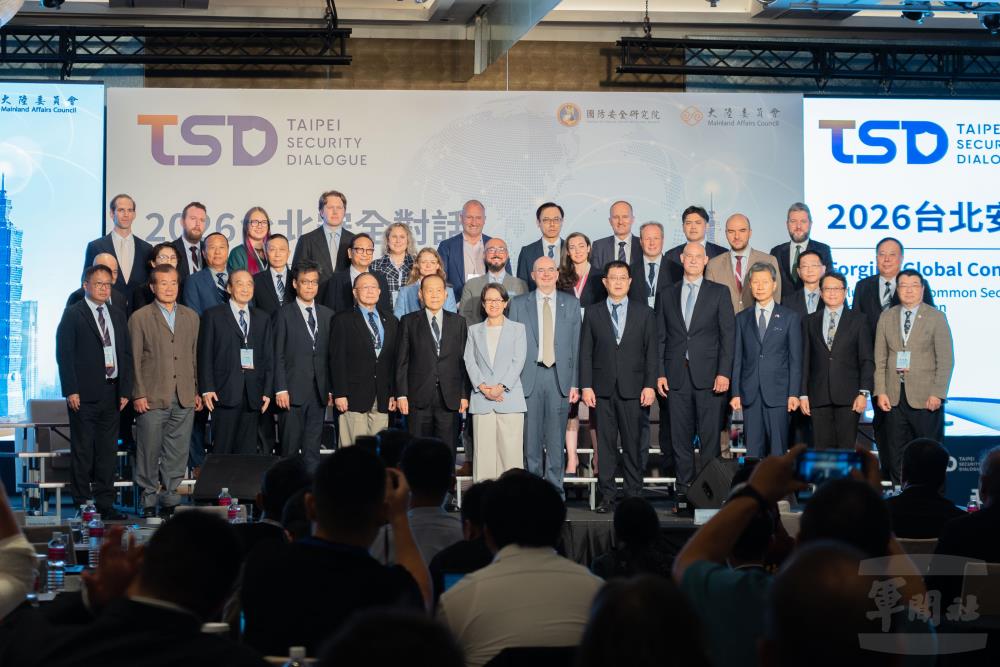
The Institute for National Defense and Security Research (INDSR) held the “2026 Taipei Security Dialogue” today. Vice President Hsiao Bi-khim, INDSR Chairman Huoh Shoou-yeh, and American Institute in Taiwan (AIT) Director Raymond F. Greene were among those attending. Under the theme “Forging Global Consensus: A Blueprint for Common Security in the Indo-Pacific Region,” the conference examined shared challenges to Indo-Pacific security in light of ongoing conflicts across Eurasia and rapid technological change. Participants also explored ways to strengthen strategic coordination and defense resilience.
The conference brought together security leaders, former government officials, think tank scholars, and practitioners from the United States, the United Kingdom, Japan, Australia, Germany, Ukraine, Poland, and other countries. Four panel discussions were held: “Navigating a New Global Security Landscape: Strategic Lessons from the Wars in Ukraine and the Middle East,” “Strategic Chokepoints and Security: The Strait of Hormuz and the Taiwan Strait,” “The Rise of Technological Innovation: Digital and Autonomous Unmanned Systems,” and “Gray-Zone Threats and Responses: Building Defense Resilience.” The panels examined common Indo-Pacific security issues from the perspectives of wartime experience, maritime security, technological innovation, and gray-zone threats.
In her remarks, Vice President Hsiao said Taiwan has a responsibility to strengthen its national defense and improve society’s preparedness for various security challenges. President Lai’s Four Pillars of Peace Action Plan provides an important national security framework centered on strengthening national defense, building economic resilience, deepening cooperation with democratic partners, and maintaining peace and stability across the Taiwan Strait.
Vice President Hsiao noted that the wars in Ukraine and the Middle East have demonstrated how decentralized command, reserve training and mobilization, and the rapid evolution of drone and counter-drone technologies are transforming the battlefield. Taiwan must establish multilayered defense capabilities and rapid mechanisms for incorporating technological feedback. It must also continue reforming its military service and reserve systems, strengthening asymmetric and air defense capabilities, and integrating artificial intelligence and emerging technologies to enhance defense effectiveness.
Vice President Hsiao emphasized that the government has proposed an unmanned systems procurement program under which coastal surveillance reconnaissance drones and coastal attack drones and small one-way attack unmanned surface vessels will be manufactured domestically. In addition to strengthening Taiwan’s defense capabilities, the program will incentivize domestic manufacturers to invest in technology and resilient production. By drawing on Taiwan’s strengths in semiconductors, information and communications technology, and precision manufacturing, the government will continue introducing innovation and emerging technologies into national defense. At the same time, government drone production and procurement, including civilian procurement, must rely on “non-red supply chains” to progressively reduce risks and dependencies while moving toward domestic production.
INDSR Chairman Huoh Shoou-yeh said the global security environment is changing rapidly and unpredictably. The war in Ukraine, conflicts in the Middle East, and developments in the Strait of Hormuz all demonstrate that peace cannot be taken for granted. Only through active defense preparations and stronger integrated deterrence can peace be maintained.
Addressing China’s continued use of gray-zone coercion, Chairman Huoh said China’s objective is to transform itself from a continental power into a maritime power. Growing alignment among authoritarian states has also formed an “axis of upheaval.” Countries should therefore move from passive responses to proactive preparedness and build a defensive network through “integrated deterrence.” Taiwan is continuing to strengthen national defense and advance whole-of-society defense resilience. By integrating national defense, civil defense, and psychological defense, it will work with like-minded countries to maintain peace, stability, and prosperity in the Indo-Pacific.
In his keynote address, AIT Director Raymond F. Greene said a conflict in the Taiwan Strait would inflict losses on the global economy exceeding those of the Second World War. The United States therefore regards maintaining peace in the Indo-Pacific as a top priority. In addition to conducting high-level diplomatic dialogue and strengthening its military presence and partnerships along the first island chain, the United States fully supports Taiwan in enhancing its self-defense capabilities.
Director Greene emphasized that the ultimate shared objective of Taiwan and the United States is not to prevail in a conflict, but to prevent one and ensure lasting peace in the Indo-Pacific. As the nature of the modern battlefield changes rapidly, Taiwan is drawing lessons from the wars in Ukraine and the Middle East concerning asymmetric warfare and the application of emerging technologies. It also demonstrated the results of its reforms through the recent Han Kuang Exercise. This reflects a fundamental change in Taiwan’s approach to national security, with the country continually strengthening its self-defense capabilities to enhance deterrence and reduce the likelihood of conflict.