- Search
Search
Search " HIMARS" ,Match:3 results
-
 Minister Koo Presents Report on M109A7 and Other Equipment–Urges Legislative Yuan to Support Budget AllocationMinister of National Defense Wellington Koo Li-hsiung attended a joint session of the Legislative Yuan’s Finance Committee and Foreign Affairs and National Defense Committee today to present a report on the draft “Special Act on Procurement for Safeguarding National Security and Strengthening Asymmetric Warfare Capabilities.” During the briefing, Minister Koo stated that the Ministry of National Defense plans to procure several major weapons systems under the special act, including the M109A7 self-propelled howitzer, the HIMARS multiple launch rocket system, anti-armor loitering munition systems, TOW 2B anti-tank missiles, and Javelin anti-tank missile systems. All systems already received Letters of Offer and Acceptance (LOA) from the United States. He urged the Legislative Yuan to approve the related budget allocations to ensure Taiwan’s armed forces possess the capabilities necessary to safeguard national security. Minister Koo noted that the first tranche of procurement items under Article 5, Paragraph 1, Items 1 through 5 of the special act totals NT$294.99 billion. For fiscal year 2026, NT$8.812 billion has been allocated for weapons procurement, logistics support, engineering infrastructure, and associated program management expenses. Among the major procurement programs, the M109A7 self-propelled howitzer program was scheduled for implementation from 2026 to 2032 with a total budget exceeding NT$80.6 billion. The HIMARS procurement program totalled more than NT$159.7 billion, while the anti-armor loitering munition systems exceeded NT$33 billion. Additional funding would support replenishment of TOW 2B anti-tank missile inventories, TOW 2B launch systems, and Javelin missile systems. Minister Koo explained that the PRC continued to expand its blue-water operational capabilities while fielding next-generation fighter aircraft, integrated ISR strike drones, naval platforms, and precision-guided missile systems. Under these evolving threat conditions, the originally planned procurement quantities were no longer sufficient to meet Taiwan’s operational requirements for counter-landing and coastal defense operations, making additional acquisitions necessary. Regarding the M109A7, Minister Koo stated that the system integrated GPS-based positioning, automated fire control, digital command-and-control capabilities, and precision fires exceeding ranges of 30 kilometers. These capabilities would enable the armed forces to strike enemy command nodes, logistics facilities, and communications centers with greater accuracy and responsiveness. Addressing joint operational effectiveness, Minister Koo noted that during integrated air and missile defense operations, HIMARS systems could conduct long-range precision strikes against enemy missile launch platforms at ranges of up to 300 kilometers. Integrated with existing Patriot, Sky Bow, and short-range air defense systems, as well as AI-enabled decision-support systems, these capabilities would contribute to a more effective layered air and missile defense network. During joint counter-landing operations, HIMARS and M109A7 systems could coordinate with coastal anti-ship missile units to rapidly engage high-value enemy targets from littoral areas to landing beaches using precision fires. Minister Koo further stated that acquisition of systems such as the Albatross II tactical maritime surveillance UAV, vertical takeoff and landing unmanned aerial systems, and coastal surveillance UAVs would significantly improve maritime domain awareness and targeting capability. These systems could support precision-guided missiles,unmanned surface vessels, and coastal strike drones in rapidly detecting and engaging hostile naval forces, thereby enhancing early warning and rapid-response strike capabilities within Taiwan’s asymmetric defense framework. Minister Koo further explained that during joint homeland defense operations, the ROC Armed Forces would deploy large numbers of surveillance UAVs to track enemy maneuver elements while integrating AI-enabled decision-support systems, the Team Awareness Kit (TAK), and the Taiwan Tactical Network (TTN) to establish a common operational picture and accelerate the sensor-to-shooter kill chain. Using precision fires, anti-armor missile systems, attack drones, and mobile interdiction operations in coordinated operations, Taiwan’s armed forces would seek to impose layered attrition against invading forces. Portable counter-UAS systems would also be deployed throughout the battlespace to defend against the PRC’s small- and medium-class drone threats. Minister Koo further stated that the HIMARS multiple launch rocket system and the M109A7 self-propelled howitzer would provide precision fire support at the operational level. Meanwhile, Javelin and TOW 2B anti-tank missiles, as well as anti-armor loitering munition systems, would enable precise engagement of enemy tanks and armored vehicles. Should Taiwan acquire a larger number of surveillance and attack UAVs, AI-enabled decision-support systems, the Team Awareness Kit (TAK), the Taiwan Tactical Network (TTN), and portable counter-UAS systems, these capabilities would significantly enhance rapid detect-and-strike operations and sustain long-term attrition against enemy forces, while also improving force protection for deployed units. Minister Koo emphasized that the procurement of the five major weapons systems, including the M109A7, would significantly enhance Taiwan’s overall joint operational capabilities. However, to fully establish the three critical pillars of a layered air defense network (the Taiwan Dome), asymmetric defense capabilities, and sustained long-term attrition against enemy forces, Taiwan also had to continue developing command-and-control systems, all-domain ISR capabilities, unmanned and counter-UAS systems, medium-range ballistic missile defense systems, and expanded domestic ammunition and equipment production capacity to enhance defense resilience.Only through the integrated development of these capabilities, Minister Koo stated, could Taiwan further strengthen its asymmetric warfare posture and defense resilience to safeguard national security.2026/05/25
 -
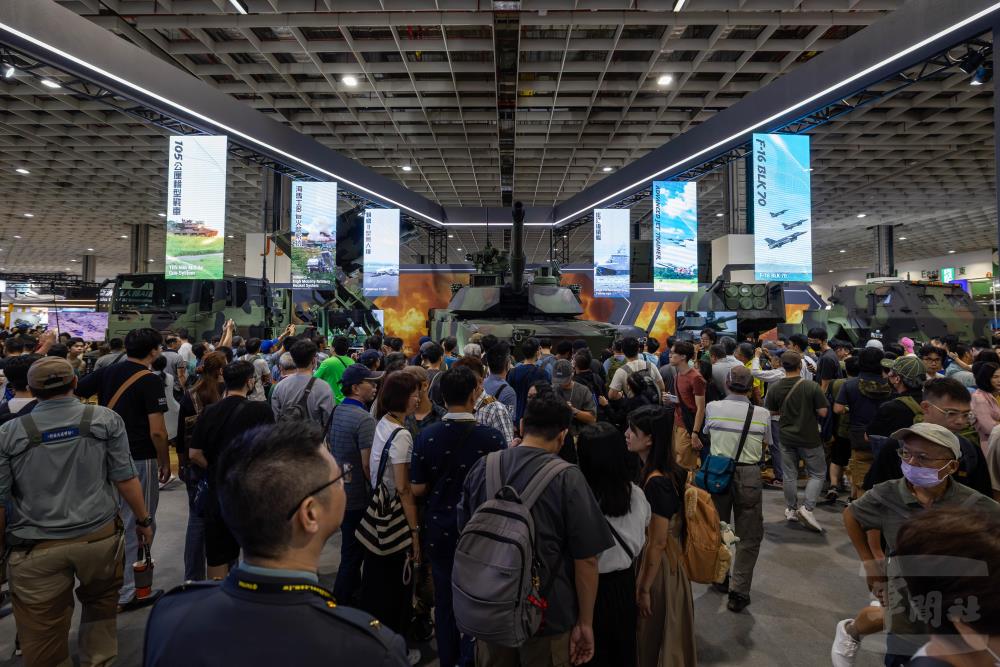 Defense Online: 2025 Taipei Aerospace Exhibition – Highlights of Weapons in the Defense Pavilion Revealed in AdvanceThis week, Defense Online will launch a series of reports on the “2025 Taipei International Aerospace and Defense Industry Exhibition” and plan two episodes to present the latest weapon highlights in the “Defense Pavilion.” The first episode, “Building Resilient National Defense,” will lead viewers to preview the joint operations weapons and equipment exhibition area, experiencing the achievements of the ROC Armed Forces’ modernization efforts in military buildup. This year’s aerospace exhibition breaks new records in scale, with 490 exhibitors from 15 countries participating, creating an unprecedented spectacle. Among them, the “Defense Pavilion” takes “resilient national defense and strengthening national power” as its main theme, showcasing 51 items of self-developed and upgraded equipment by the ROC Armed Forces, fully presenting the results of defense self-reliance and becoming the focal point of the entire event. The program content will particularly introduce key equipment such as the Strongbow Missile System, 2.75-inch Rocket Vehicle-Mounted Turret, M1A2T Tank, Himars Multiple Launch Rocket System, and 105mm Wheeled Tank, and invite experts and senior foreign media reporters to share their tactical value, fully demonstrating the ROC Armed Forces’ overall combat power of “resolute defense and multi-layered deterrence.” In the face of rapidly changing security challenges, the ROC Armed Forces continues to integrate joint operations effectiveness, developing the “multi-domain denial and resilient defense” readiness direction to strengthen national power and resilient national defense, safeguarding national security and maintaining regional peace. The “2025 Taipei International Aerospace and Defense Industry Exhibition – Building Resilient National Defense” will premiere on Thursday (December 2) at 2:00 PM on the Chinese Television System channel, with rebroadcasts on Friday at 2:00 PM and Saturday at 8:00 AM. The public is also welcome to watch on the “Military News Agency” website and YouTube channel to witness together the solid achievements of the ROC Armed Forces in military buildup and readiness.2025/10/01
 -
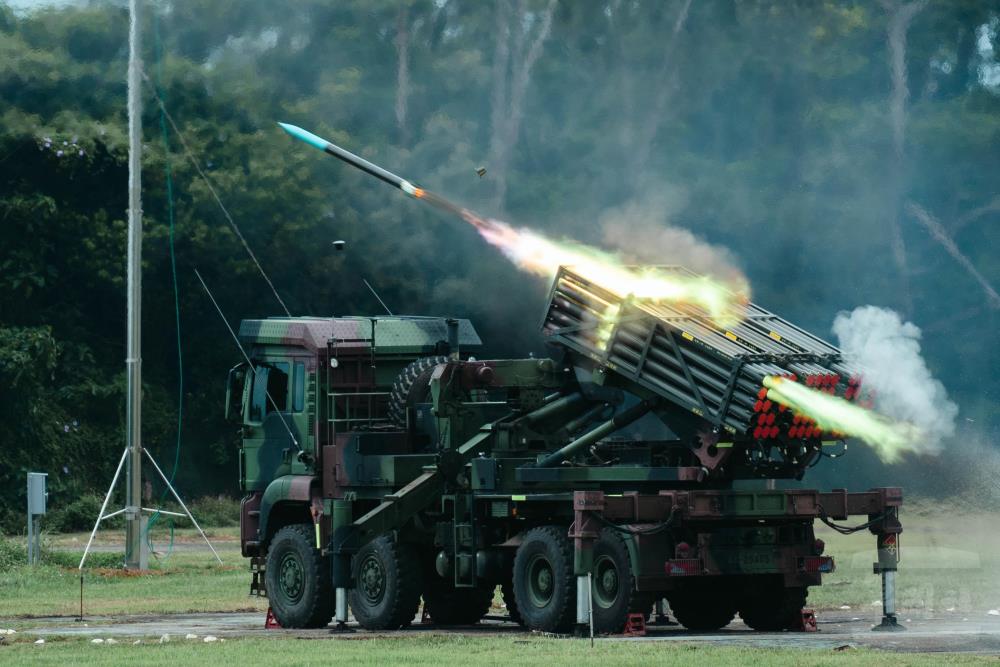 2025 Precision Missile Firing Exercise: Artillery Units Demonstrate Robust Combat StrengthTo validate training effectiveness, the Army conducted the 2025 Precision Missile Firing Training at Jiupeng Base in Pingtung today. In the morning, live-fire exercises of the Thunderbolt 2000 Multiple Rocket System were carried out, while in the afternoon, media were invited to observe the High Mobility Artillery Rocket System (HIMARS) firing, showcasing the Army artillery’s superior strike capabilities and training outcomes through media coverage. This morning, personnel from the rocket companies of the Army’s 21st, 58th, and 43rd Artillery Command, as well as units from the Kinmen Defense Command, Matsu Defense Command, and the 2nd Training Company of the Artillery Training Command, conducted the “Thunderbolt” exercise, simulating countering enemy landings by firing at sea targets to validate the training effectiveness of the troops. In the afternoon, the 58th Artillery Command conducted live-fire exercises with the HIMARS, demonstrating its high mobility and precision strike capabilities to the public through media coverage, highlighting the ROC Armed Forces’ firepower and military readiness achievements. The Army Command stated that the HIMARS is a high-mobility rocket launch platform procured from the United States, equipped with rapid deployment and precision strike capabilities. The first batch of 11 HIMARS units, acquired from the U.S., arrived last year and is currently undergoing integration training by the Army’s 58th Artillery Command. The Army Command noted that this firing exercise, aligned with the “Annual Precision Missile Firing Exercise,” verified the integration training effectiveness of the HIMARS. During the exercise, participating personnel demonstrated high professionalism and coordination, successfully completing the firing mission and accumulating valuable firing experience, achieving the goal of enhancing combat readiness.2025/05/12